
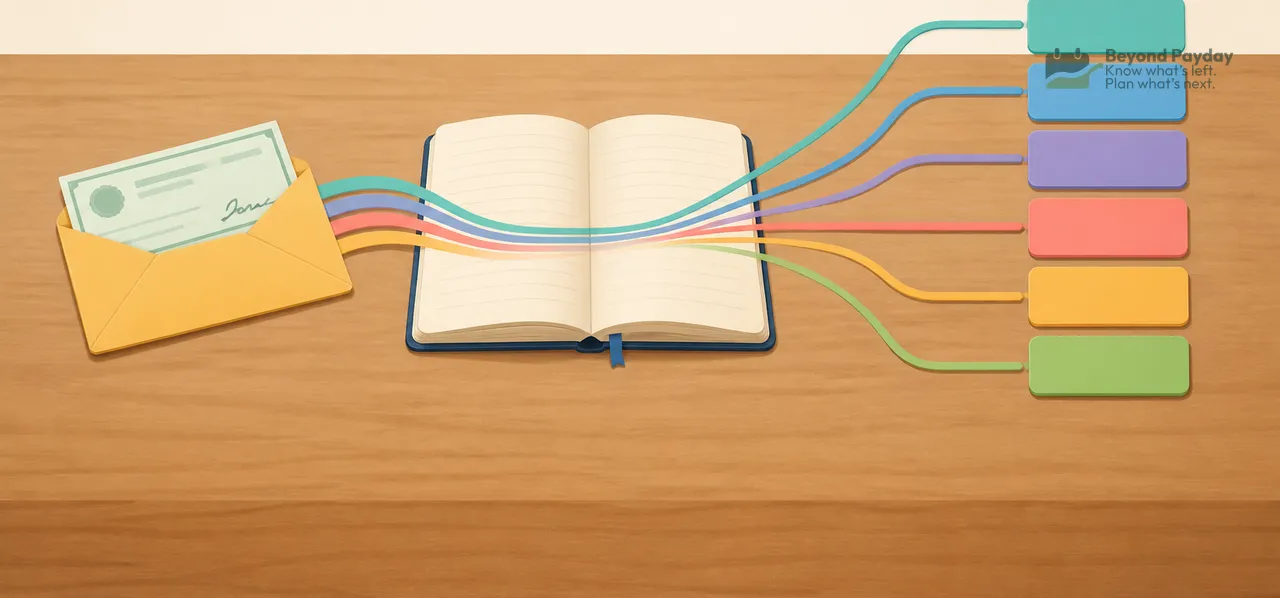
Zero-based budgeting means you give every dollar of your take-home pay a job (bills, spending, savings, debt payments) until income minus everything you've assigned equals exactly zero. It does not mean spending everything or leaving $0 in the bank. Savings is a job too, so a zero-based budget can still put hundreds of dollars a month toward the future.
- "Zero" is about the plan, not your balance. Income minus assigned dollars = $0. Savings and debt payments count as assigned.
- You plan with money you actually have. Most people budget their take-home pay, one month (or one paycheck) at a time.
- It's the most hands-on budget style. More control than a percentage rule like 50/30/20, but more upkeep.
- Irregular income works with a "buffer month": live on last month's income so this month's plan is never a guess.
- Most zero-based budgets fail for the same few reasons: forgotten yearly bills, no room for mistakes, and quitting after the first overspend.
What "zero-based" actually means
The takeaway: every dollar gets a name before the month starts. Nothing sits in a vague "left over" pile.
- Income in: your take-home pay for the month, after taxes and payroll deductions.
- Dollars out: every planned use of that money, including savings transfers and extra debt payments.
- The goal: income − planned uses = $0.
- If you're above zero, you have unassigned money. You give it a job (savings, a goal, an extra debt payment).
- If you're below zero, you've planned more than you have. You trim a category until it balances.
This is the core of what the CFPB describes in its guide to creating a budget and sticking with it: know what comes in, decide where it goes, and compare against what really happens.
Note
A bit of history. The idea started in business, not households. Peter Pyhrr introduced "zero-base budgeting" from his work at Texas Instruments in a 1970 Harvard Business Review article, as McKinsey recounts. Companies justify each cost from scratch instead of copying last year's numbers. The household version borrows that spirit: no line gets money just because it got money last month.
How to build a zero-based budget in six steps
The takeaway: start with your real take-home pay, then fill categories in priority order.
- Write down this month's take-home income. Use deposits you expect, not your salary. If you're paid biweekly, note which months have a third paycheck.
- List fixed essentials first. Rent or mortgage, utilities, insurance, minimum debt payments, child care, transportation.
- Add variable essentials. Groceries, gas, medicine. Use your last two or three months of spending as a guide.
- Add sinking funds. Divide each yearly or irregular cost by 12. See what a sinking fund is for more.
- Assign savings and extra debt payments. Emergency fund, retirement, a goal, or paying above the minimum.
- Give the rest to wants, then balance to zero. Dining out, hobbies, fun money. Adjust until the total matches your income exactly.
A simple zero-based budget example
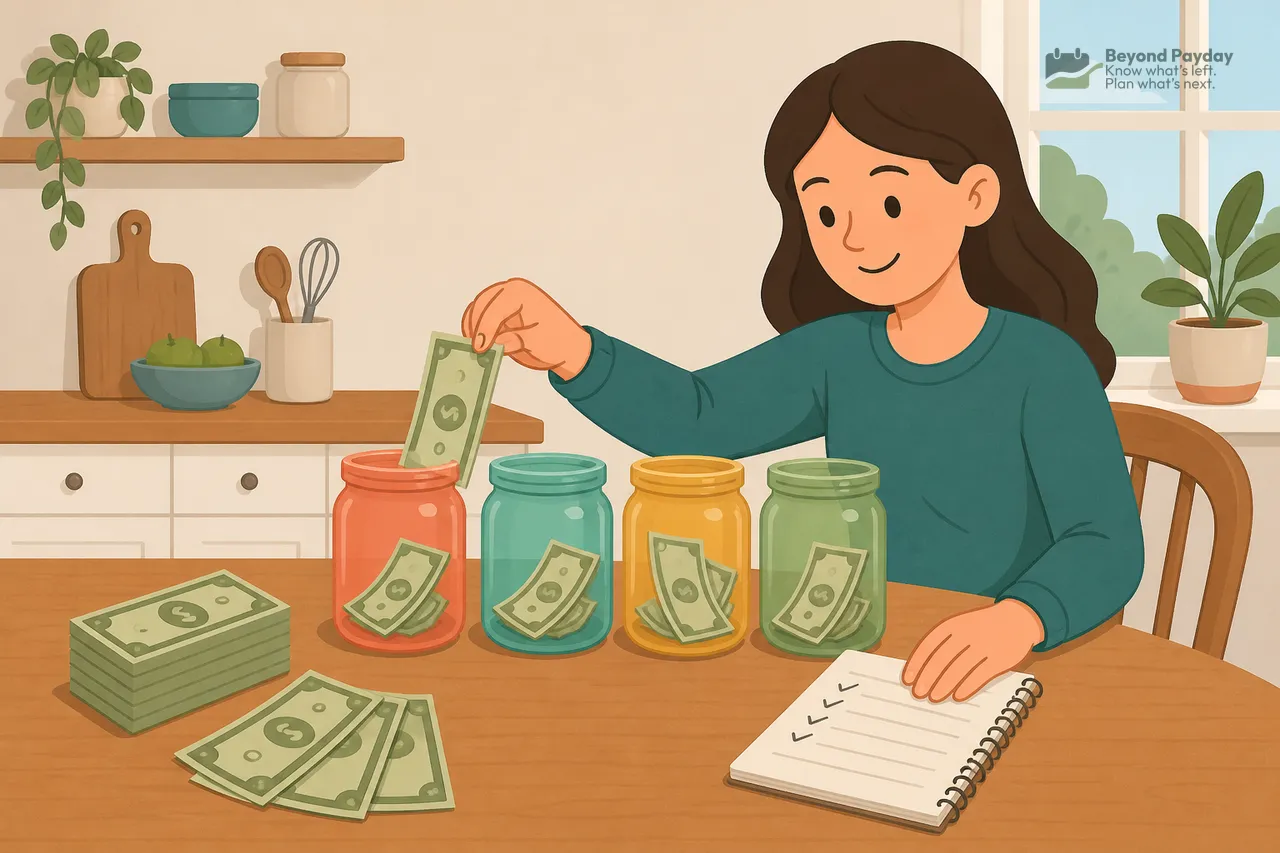
The takeaway: once every line is filled, the "remaining" row reads $0. The numbers below are an illustrative example for one person with $4,200 a month in take-home pay. They are not a recommendation.
| Category | Planned (example) |
|---|---|
| Rent | $1,450 |
| Utilities and phone | $230 |
| Car payment and insurance | $520 |
| Gas | $160 |
| Groceries | $480 |
| Minimum credit card payment | $90 |
| Sinking funds (car repairs, gifts, annual fees) | $200 |
| Emergency fund transfer | $300 |
| Extra credit card payment | $150 |
| Dining out | $180 |
| Fun money and hobbies | $140 |
| Clothing and personal care | $100 |
| "Oops" line (small surprises) | $50 |
| Subscriptions | $50 |
| Gifts and giving | $100 |
| Total assigned | $4,200 |
| Income − assigned | $0 |
Notice two things in the example:
- $450 goes to the future (emergency fund plus the extra debt payment) and the budget still balances to zero.
- There's an "oops" line. A zero-based budget with no slack tends to break in week two.
Zero-based budgeting vs 50/30/20
The takeaway: 50/30/20 sets the size of three buckets; zero-based fills in every line. Many people use 50/30/20 as a starting shape, then use zero-based budgeting to plan the details. The CFPB's spending rule worksheet describes the 50% needs, 30% wants, 20% savings guideline and notes it can be adapted. Our 50/30/20 rule explainer covers it in depth.
| Zero-based | 50/30/20 | |
|---|---|---|
| What you decide | A dollar amount for every category | Three percentages |
| Time each month | More: you plan and review each line | Less: you check three totals |
| Flexibility | Very high; categories change each month | Fixed shape, flexible inside each bucket |
| Best at | Finding leaks, tight months, specific goals | Quick check on overall balance |
| Common weak spot | Takes effort to maintain | High-cost-of-living areas can push "needs" well past 50% |
| Works with irregular income? | Yes, especially with a buffer month | Harder, because percentages of a moving number move too |
Tip
You don't have to pick one. One common approach: check your shape against 50/30/20 a couple of times a year, and run zero-based month to month.
Zero-based budgeting on an irregular income
The takeaway: budget the money you already have, not the money you hope to earn. Irregular income is common. In the Federal Reserve's survey of 2025 household finances (published in 2026), 30% of adults said their income varied at least occasionally through the year, and 11% said they struggled to pay bills in the prior 12 months because of it.
Ways people adapt zero-based budgeting when pay jumps around:
- Plan a "bare-bones" month first. List only the essentials you'd need to cover in your lowest-earning month. That's your floor.
- Rank everything above the floor. As money arrives, you fund the next item on the list: savings, then extra debt, then wants.
- Budget per deposit, not per month. Each time a payment lands, give that money jobs right away until it reaches zero.
- Smooth with a holding account. Some people send all income to one savings account, then "pay themselves" a steady amount into checking.
- Set aside taxes first if you're self-employed. Income with no withholding may need quarterly estimated tax payments, so that money isn't really yours to assign.
For a full walkthrough of variable pay, see how to budget on an irregular income.
The "buffer month": living on last month's income
The takeaway: once you're one month ahead, every budget is built from money already in the bank. Many zero-based budgeters see it as the upgrade that makes the method easiest to keep.
How it works:
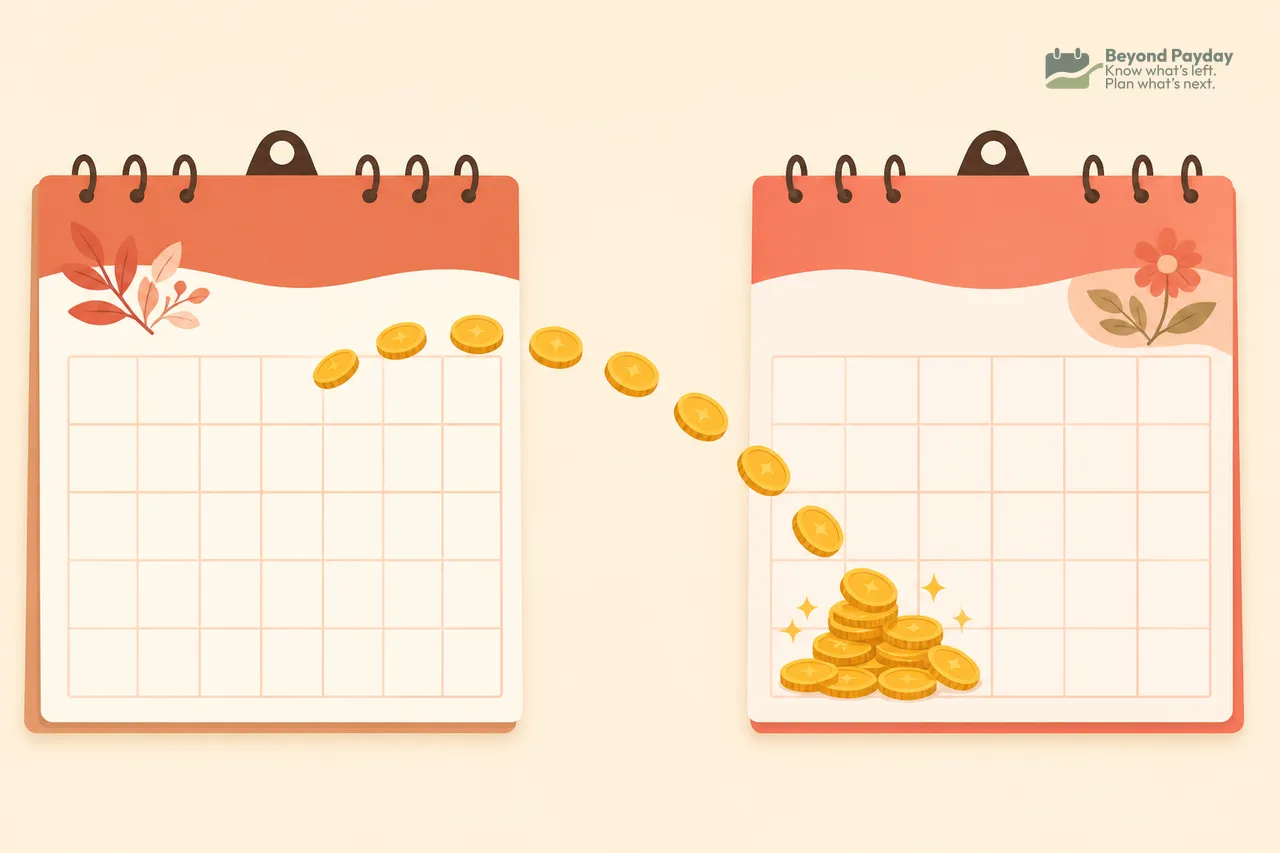
- This month, you spend money you earned last month. Everything you earn this month goes into a holding pot for next month.
- On the 1st, you budget the whole pot. You know the exact number, so the plan isn't a guess.
- Payday timing stops mattering. A bill due on the 3rd and a paycheck on the 15th no longer collide.
How people usually build one:
- Set a target: one month of your planned spending (in the example above, $4,200).
- Add a "buffer" line to your zero-based budget. Even $100–$300 a month counts.
- Route windfalls to it. Tax refunds, a third paycheck, a bonus, money from selling something.
- Switch over when it's full. From then on, each month's income funds the next month.
Watch out
A buffer month is not an emergency fund. It covers timing, not shocks. If you dip into it for a car repair, you're back to budgeting from paychecks you haven't received yet. Many people build a small emergency fund first, then the buffer.
Why zero-based budgets fail (and the fixes)
The takeaway: the method rarely fails; the setup does. These are the most common failure points.
- Forgetting non-monthly costs. Car registration, a yearly insurance premium, back-to-school, holidays. Example: $2,400 a year of these costs is $200 a month that seems to "come out of nowhere" unless you plan it as a sinking fund.
- Budgeting gross pay. Taxes, retirement contributions and health premiums come out first. Budget the deposit that actually lands.
- No slack. A plan with no "oops" or miscellaneous line breaks the first time a prescription costs more than expected.
- Treating an overspend as failure. Moving money between categories mid-month is part of the method, not cheating. Overspent groceries by $40? Take $40 from dining out, and the budget still balances.
- Too many categories. Thirty lines is a lot to track. Many people do fine with 10–15.
- Never comparing plan to reality. The CFPB's Your Money, Your Goals toolkit includes spending trackers for exactly this. A plan you never check stops being a plan.
- Planning alone when money is shared. If a partner spends from the same account without seeing the plan, the numbers won't hold.
- Starting in a hard month. December, or a month with a big annual bill, makes the first try feel impossible.
What zero-based budgeting looks like for different people
The takeaway: the method is the same; the pressure points differ. These are general patterns, not prescriptions.
| Situation | What tends to matter most |
|---|---|
| Single, steady paycheck | Quick setup. The main risk is boredom: a monthly 20-minute review keeps it alive. |
| Couple with shared bills | Agreeing on categories and who tracks what. A shared "fun money" line for each person cuts friction. |
| Parent | Sinking funds for school costs, activities, birthdays and child care gaps. |
| Self-employed or gig worker | Tax set-aside first, then a bare-bones floor and the buffer month. |
| Paid biweekly | 26 paychecks over 12 months means most years have two months with three paychecks. Budget on two, and give the third a planned job. See biweekly vs semi-monthly pay. |
| Near or in retirement | Income may arrive from several sources on different dates; a buffer month smooths them into one plan. |
A quick checklist before your first month
- Do I know my real take-home income for this month (or my lowest likely month)?
- Are yearly and irregular costs turned into monthly sinking funds?
- Is there an "oops" line?
- Does savings or debt payoff have a line, even a small one?
- Does income − assigned = $0?
- When will I check plan vs actual? (Many people pick a weekly 10-minute check.)
- Do I have a plan for windfalls (refunds, third paychecks, bonuses) before they arrive?
A zero-based budget is easier to keep when you can see bills, paydays and categories in one place, and test a change before you make it.
FAQ
Does zero-based budgeting mean having $0 in the bank?
No. The zero refers to unassigned money in your plan, not your account balance; savings and debt payments count as assigned dollars.
Is zero-based budgeting better than the 50/30/20 rule?
They do different jobs. 50/30/20 sets three broad percentages, while zero-based budgeting plans every category in dollars, so many people use both.
Can you do zero-based budgeting with irregular income?
Yes. Common adaptations are budgeting each deposit as it arrives, planning a bare-bones floor for low months, and building a buffer so you spend last month's income.
What is a buffer month in budgeting?
It's having one month of planned spending saved so you budget money you earned last month. It smooths payday timing but is separate from an emergency fund.
What happens if I overspend a category?
In zero-based budgeting you move money from another category so the plan still balances to zero. Adjusting mid-month is part of the method.
Related reading
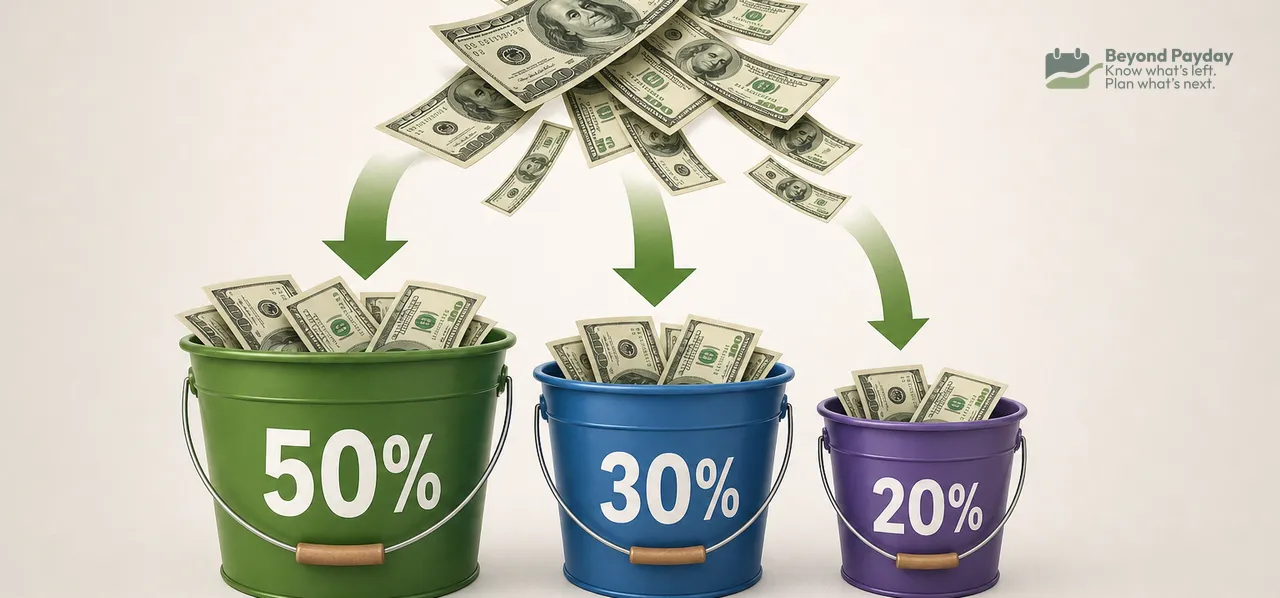
The 50/30/20 budget rule, explained
The 50/30/20 rule splits your take-home pay into needs, wants, and savings. Here's exactly how the math works, a full example, and where the rule breaks down.

How to budget on an irregular or variable income
Freelancers, commission earners, and gig workers can still budget with confidence. The key is budgeting off your lowest month, not your average.
What is a sinking fund? The budget line most plans miss
Sinking funds are small monthly deposits set aside for expenses you know are coming — like car registration or holiday gifts — so they never blow up your budget again.
Beyond Payday is a planning tool, not a financial advisor. This article is educational. Projections and examples are estimates, not financial, tax, or investment advice.