

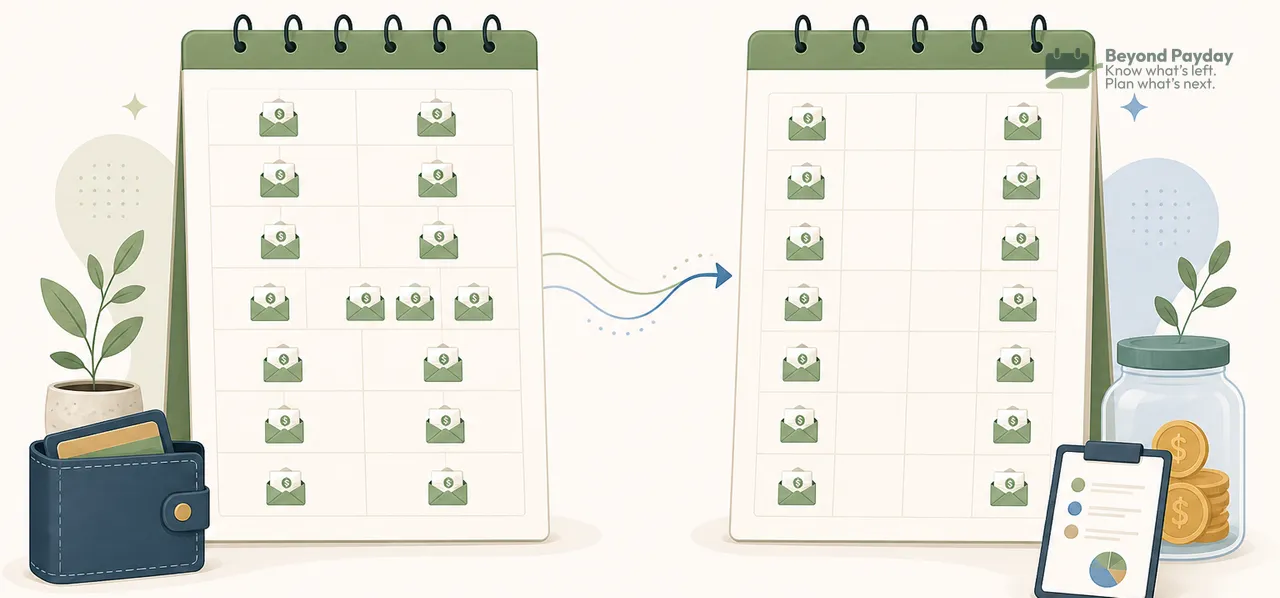
Bi-weekly pay means you get paid every two weeks — 26 times a year. Semi-monthly pay means you get paid twice a month on set dates — 24 times a year. Same annual salary can feel completely different to budget with, because the math behind the two schedules doesn't line up the way most people assume.
- Bi-weekly = 26 paychecks a year, semi-monthly = 24 paychecks a year — same salary, different slices.
- Because 26 doesn't divide evenly into 12 months, bi-weekly schedules produce two months a year with three paychecks — and roughly once every 11 years, a 27th payday adds a third such month.
- Semi-monthly checks are about 8.3% bigger than bi-weekly checks for the same salary, since the total is split fewer ways.
- The classic bi-weekly budgeting error is dividing salary by 12. Ten months a year, two checks come up about 7.7% short of that number.
- Monthly bills line up more predictably with semi-monthly pay, since it always delivers exactly two checks a month.
- Flat-dollar deductions taken per paycheck (not per month) can add up to different annual totals depending on whether they're taken 24 or 26 times.
The math: 26 vs 24 paychecks
The difference starts with how each schedule divides the year.
- Bi-weekly pay follows the calendar week, not the calendar month. Every 14 days, a paycheck arrives, regardless of which month it lands in.
- Semi-monthly pay follows the calendar month instead. It always delivers two paychecks per month, no more and no less.
Because 26 paychecks don't divide evenly across 12 months (26 ÷ 12 ≈ 2.17), some months on a bi-weekly schedule end up with three paychecks instead of two. Semi-monthly pay never has this problem — it's built around the month, so it's always exactly two.
Why bi-weekly pay creates "extra paycheck" months
A bi-weekly schedule pays out every 14 days without regard to month boundaries, so paydays gradually drift earlier in the month over the course of a year.
- Every month gets at least two paydays, since no month is shorter than 28 days. That accounts for 24 of the 26 checks.
- The other two land as a third check in two separate months. Which months depends on your employer's first payday of the year.
- 2026 example: on a Friday schedule starting January 2, the three-check months are January and July. A schedule starting January 9 gets them in May and October.
- The 27-paycheck year. A year is 52 weeks plus a day or two, so paydays slide about a day later each year. Roughly every 11 years, that drift squeezes a 27th payday into one calendar year. Salaried employers handle this differently — some keep the per-check amount (so the year's total runs higher), others divide the salary by 27 (so each check shrinks).
Semi-monthly pay doesn't have this quirk at all. Every month, without exception, delivers exactly two paychecks — the total for the year is fixed at 24 from the start.

Why each semi-monthly check is bigger
Same annual pay, split fewer ways, means each check has to be larger.
- Splitting a salary into 24 payments instead of 26 means each payment carries a slightly bigger share of the annual total.
- The difference works out to about 8.3% larger per check on semi-monthly pay compared to bi-weekly pay for an identical salary (26 ÷ 24 ≈ 1.083).
- This can make a semi-monthly paycheck feel like a raise compared to a bi-weekly one, even when the underlying salary is exactly the same.
Note
Neither schedule changes how much you're paid over a full year. It only changes how that same total is sliced and when it lands in your account.
How monthly bills line up against each schedule
This is where the two schedules feel most different day to day, since almost every recurring bill — rent, a mortgage, a phone plan, a streaming subscription — runs on a monthly cycle, not a two-week one.
| Bi-weekly (26/yr) | Semi-monthly (24/yr) | |
|---|---|---|
| Paychecks per month | Usually 2, sometimes 3 | Always exactly 2 |
| Paycheck size | Smaller, more consistent | Larger, evenly split |
| Alignment with monthly bills | Drifts across the month over the year | Stays fixed to set dates each month |
| Predictability month to month | Lower — payday dates shift | Higher — same two dates every month |
| "Extra" money moments | 2 three-paycheck months a year (3 in a 27-pay year) | None — total is always fixed at 2/month |
- On a bi-weekly schedule, the gap between a payday and a bill's due date shrinks and grows over the year as paydays drift, which is part of why some months feel tight and others feel flush.
- On a semi-monthly schedule, a bill due on a fixed date (say, the 1st) sits in a consistent relationship to your paydays every single month, which makes it easier to build a fixed monthly budget around.
How per-paycheck deductions differ from per-month deductions
Some deductions come out as a flat dollar amount every paycheck; others are calculated as a percentage of that paycheck's gross pay. The difference matters more than most people expect.
- Percentage-based deductions — like Social Security and Medicare (FICA) — scale automatically with the size of each check, so they self-correct regardless of pay frequency, per IRS guidance on employment taxes.
- Federal income tax withholding is calculated using tables that account for how many pay periods you have in a year, so the dollar amount withheld per check differs between a 24-period and a 26-period schedule even at identical income, per the IRS's overview of tax withholding.
- Flat-dollar benefit deductions — a fixed health insurance premium taken "per paycheck," for example — don't scale the same way. If a plan is designed around 24 deductions a year but you're paid 26 times, either the per-check amount is set lower to spread evenly across 26 checks, or it's taken only in the months with a "normal" two paychecks and skipped in extra-paycheck months. Policies vary by employer, so it's worth checking the specifics with a payroll or benefits contact rather than assuming.
Watch out
Don't assume a flat per-check deduction automatically adds up to the same annual total regardless of pay frequency — check with payroll or HR on how a specific deduction is structured before counting on a certain take-home number.
Budgeting on each schedule: the two traps to avoid
The schedule itself doesn't create problems — the trouble comes from budgeting as if it were the other one.
Trap 1: Treating a three-paycheck month as free money (bi-weekly)
- The "extra" paycheck in a three-paycheck month isn't a bonus — it's part of the salary you were already promised, arriving on the calendar's schedule instead of yours.
- The mirror-image mistake is budgeting off salary ÷ 12. On $60,000, that's $5,000 a month gross, but a normal two-check month delivers about $4,615. Ten months a year come up roughly $385 short, and the difference only shows up in the two three-check months.
- A steadier approach many people use is to budget monthly essentials off the two-paycheck baseline and treat any third-paycheck months as a chance to fund something specific — an emergency fund, extra debt payments, or a sinking fund for a known upcoming cost — rather than folding it into everyday spending.
Trap 2: Budgeting semi-monthly pay as if every month is identical (semi-monthly)
- Semi-monthly pay always gives exactly two checks a month, but the dates rarely match when bills are due. With paydays on the 15th and the last day of the month, rent or a mortgage due on the 1st can swallow most of the end-of-month check, leaving the mid-month check to carry everything else.
- When a payday falls on a weekend or holiday, many employers pay on the prior business day — so the gap between checks can stretch or shrink by a few days.
- Assuming every paycheck is evenly available for every bill, without checking exact due dates against exact pay dates, is a common way a semi-monthly budget quietly falls short some months even though the totals work out fine on paper.
Trap 3 (hourly workers): expecting overtime on the next check
- Federal overtime is figured by the workweek, not the pay period, per the U.S. Department of Labor. On a semi-monthly schedule, a workweek often straddles two pay periods, so overtime worked late in one period may not show up until the following check.

An example with round numbers
Illustrative numbers; real take-home also depends on tax withholding, benefits, and other deductions.
- Assumption: a $60,000 annual gross salary, before taxes or deductions.
- Bi-weekly (26 paychecks): $60,000 ÷ 26 = $2,307.69 per check (gross).
- Semi-monthly (24 paychecks): $60,000 ÷ 24 = $2,500.00 per check (gross).
- Difference per check: about $192, or roughly 8.3% more per semi-monthly check — but the annual gross total is identical either way.
- Extra-paycheck effect: in a bi-weekly three-paycheck month, that same person would receive roughly $2,307.69 × 3 ≈ $6,923 in gross pay that month, compared to a typical two-paycheck month of about $4,615 — a noticeable but temporary jump, not a raise.
Putting it together
- Bi-weekly and semi-monthly pay can total the exact same annual income — the felt difference is entirely about timing and slicing.
- Knowing which schedule you're on, and building a budget around its real rhythm rather than a rounded assumption, tends to prevent the two most common surprises: a spent-too-fast "bonus" month, or an unexpectedly tight month with a bill due before payday catches up.
FAQ
Is bi-weekly pay better than semi-monthly pay?
Neither schedule pays you more over a year — it's the same annual salary split differently. Which one feels easier to budget with usually comes down to personal preference and how your bills line up with paydays.
How many months a year have three paychecks on a bi-weekly schedule?
Two in a typical year, because 26 paychecks is two more than the 24 that two-a-month would give. Roughly once every 11 years, a 27th payday falls in the same calendar year and a third month gets three checks.
Why is my semi-monthly paycheck bigger than a coworker's bi-weekly one?
Semi-monthly pay is split into 24 paychecks a year instead of 26, so each individual check is larger even though the annual total can be the same.
Do payroll deductions change depending on pay frequency?
Flat-dollar deductions taken per paycheck (like a set health insurance premium) can add up to a different annual total depending on whether they're taken 24 or 26 times a year, so it's worth checking how your employer structures them.
Does federal tax withholding differ between bi-weekly and semi-monthly pay?
Yes. Employers calculate withholding using tables built around a set number of pay periods per year. So the dollar amount withheld per check differs between the two schedules even when annual income is identical, per IRS guidance on tax withholding.
Related reading

Why is my paycheck so much smaller than my salary?
Your salary is a yearly number; your paycheck is what's left after taxes and benefits come out of each pay period. Here's a line-by-line walk from gross pay to net pay, so nothing on your stub is a mystery.

Pre-tax vs post-tax payroll deductions: what's the difference?
A $200 pre-tax deduction doesn't cost you $200 of take-home pay — but it doesn't disappear from the IRS's radar forever either. Here's how each bucket actually works.

How to budget on an irregular or variable income
Freelancers, commission earners, and gig workers can still budget with confidence. The key is budgeting off your lowest month, not your average.
Beyond Payday is a planning tool, not a financial advisor. This article is educational — projections and examples are estimates, not financial, tax, or investment advice.