

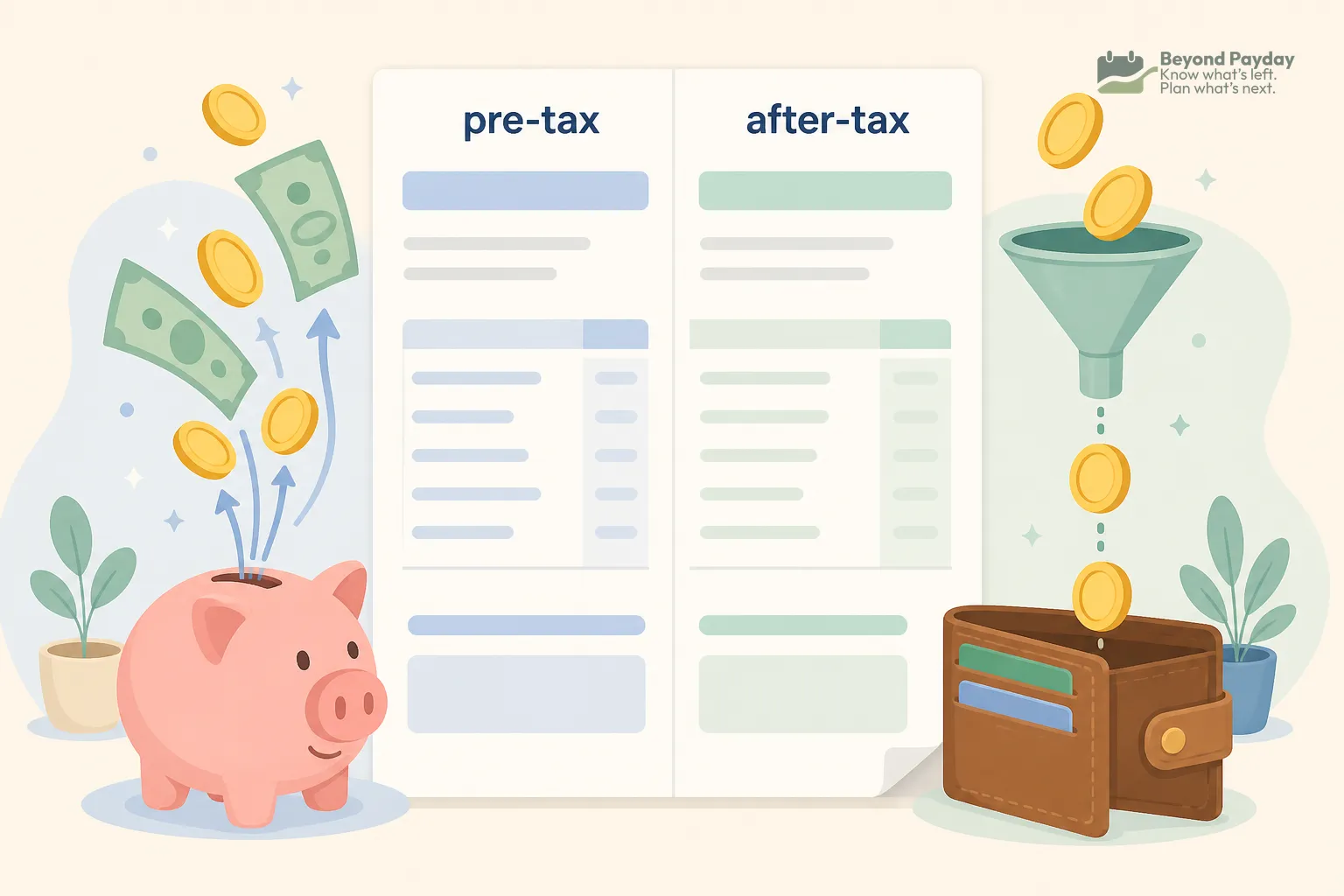
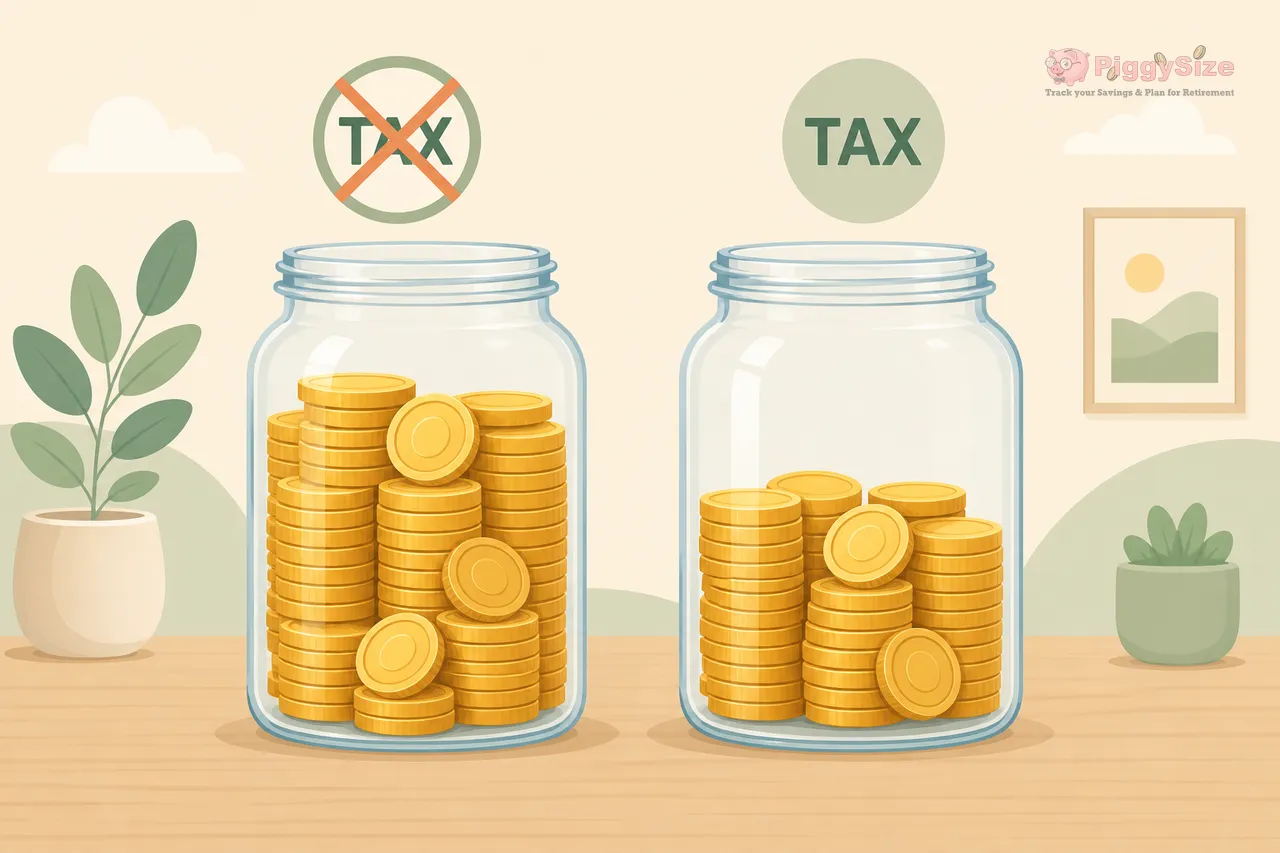
Pre-tax deductions come out of your pay before income tax (and sometimes other payroll taxes) is calculated. Post-tax deductions come out after — so they don't lower the amount you're taxed on today. Neither one is automatically "better"; they just move money at different points in the paycheck, with different consequences down the road.
- Pre-tax deductions (traditional 401(k), most health premiums, HSA, FSA, commuter benefits) reduce the wages your income tax is calculated on, so they cost less than their face value in take-home pay. Not all pre-tax is equal: cafeteria-plan and commuter benefits usually skip Social Security and Medicare tax too; a traditional 401(k) doesn't.
- Post-tax deductions (Roth 401(k), garnishments, union dues, many disability premiums) come out of pay that's already been taxed, so a $200 deduction reduces your paycheck by the full $200.
- "Pre-tax" usually means taxed later, not never — traditional retirement contributions are generally taxed when withdrawn in retirement.
- The same deduction type can be pre-tax at one employer and post-tax at another, or optional either way, depending on how the plan is set up.
- Paying disability premiums post-tax is one of the few cases where paying more now can mean paying less tax later, since the benefit itself may not be taxed.
What "pre-tax" and "post-tax" actually mean
Every paycheck starts with gross pay Deductions are subtracted in a specific order, and where a deduction sits in that order changes how much tax you pay.
- Pre-tax deductions are subtracted from gross pay before federal income tax withholding is calculated. Some pre-tax deductions also reduce the wages used for Social Security and Medicare tax; others only reduce federal (and often state) income tax wages. Which taxes a given deduction avoids depends on the specific plan.
- Post-tax deductions are subtracted after taxes are calculated and withheld. They reduce your net pay dollar-for-dollar but have no effect on how much tax was withheld.
- The IRS describes how income tax is withheld from wages and how federal income tax, Social Security, and Medicare taxes apply to pay — pre-tax deductions work by shrinking the wage figure those calculations start from.
Common deductions, mapped to their bucket
This is the general pattern most employer plans follow — but plan design varies, and the same benefit can be structured differently from one employer to the next.
| Deduction | Typical bucket | Notes |
|---|---|---|
| Traditional 401(k) / 403(b) contribution | Pre-tax | Lowers federal (and usually state) taxable wages; typically still subject to Social Security and Medicare tax |
| Roth 401(k) contribution | Post-tax | No upfront tax break; qualified withdrawals in retirement are generally not taxed |
| Health insurance premium | Usually pre-tax | Runs through an employer's cafeteria plan where offered; some plans offer only a post-tax option |
| HSA contribution via payroll | Pre-tax | Requires a qualifying high-deductible health plan. Through payroll it also skips FICA; money you put in directly and deduct on your return does not |
| Health FSA contribution | Pre-tax | Comes with use-it-or-lose-it rules that vary by plan |
| Dependent care FSA | Pre-tax | Covers eligible child or dependent care; a household limit, not per parent |
| Commuter / transit or parking benefit | Pre-tax, up to a monthly limit | Only available if the employer offers the program |
| Disability insurance premium | Often post-tax | Paying the premium post-tax is one common way plans arrange for the future benefit to not be taxed as income; rules are plan-specific |
| Life insurance premium (employer group) | Mixed | Employee-paid supplemental coverage is often post-tax; employer-paid group coverage above $50,000 adds its cost to your taxable wages as imputed income |
| Union dues | Typically post-tax | Deducted after taxes under most current arrangements |
| Wage garnishment | Post-tax, mandatory | Calculated on pay after required tax withholding; not elective |
Note
This table shows common patterns, not universal rules. Whether a specific deduction is pre-tax on your paycheck depends on your employer's plan documents — your HR or benefits team, or the plan's summary description, is the definitive source.
The 2026 limits at a glance
Pre-tax room is capped, and the caps change yearly. For 2026, per the IRS:
| Benefit | 2026 limit |
|---|---|
| 401(k) / 403(b) employee deferrals (traditional + Roth combined) | $24,500; +$8,000 catch-up at 50+; +$11,250 instead at ages 60–63 |
| HSA | $4,400 self-only / $8,750 family; +$1,000 at 55+ |
| Health FSA | $3,400 (plans may allow up to $680 to carry over) |
| Dependent care FSA | $7,500 per household, up from $5,000 under the 2025 tax law |
| Commuter transit / parking | $340 a month each |
Why a pre-tax deduction costs less than its face value
Because income tax applies to a smaller number once a pre-tax deduction is subtracted, the actual hit to your take-home pay is less than the deduction amount.
- Your paycheck's federal income tax withholding is calculated on wages after pre-tax deductions are removed, following the framework the IRS lays out for payroll tax withholding.
- Federal income tax uses a marginal tax bracket system, so the value of shielding one more dollar from tax depends on which bracket that dollar would have landed in, as described in the IRS's overview of federal tax rates and brackets.
- Which taxes it skips matters. A traditional 401(k) deferral dodges income tax only. A cafeteria-plan health premium or payroll HSA contribution dodges income tax and the 7.65% employee share of FICA (IRS Publication 15-B).
- A post-tax deduction of the same dollar amount doesn't get this treatment — the tax was already withheld on that money before the deduction happened.
Tip
This is why two coworkers who each put "$200 into the 401(k) menu" can see different changes in take-home pay if one chose the traditional (pre-tax) option and one chose Roth (post-tax) — same contribution, different paycheck math.
The trade-off people miss: taxed later, not never
A pre-tax deduction isn't free money — for most retirement accounts, it's a timing shift, not a tax exemption.
- Traditional 401(k)/403(b) and traditional IRA contributions are generally excluded from taxable income now, but distributions in retirement are typically taxed as ordinary income.
- Roth accounts flip this: contributions are post-tax now, and qualified withdrawals are generally not taxed later.
- HSAs are the exception many people don't realize is special — money can go in pre-tax and come out tax-free too, as long as it's used for qualifying medical expenses, which is different from the "pay tax eventually" pattern of traditional retirement accounts.
- FSAs are pre-tax going in and generally not taxed coming out either, but they carry stricter use-it-or-lose-it timing.
- Skipping FICA has a small cost. Wages that avoid Social Security tax also don't count toward your Social Security earnings record, which can trim a future benefit slightly. For most people it's minor next to the savings, but it's real.
The practical question isn't just "pre-tax or post-tax" — it's when you'd rather owe the tax, and that depends on things like expected future tax rates, current cash flow, and what the money is for. None of that has one right answer for everyone.
Post-tax deductions worth understanding on their own
A few post-tax items behave differently enough from a simple "Roth contribution" that they're worth calling out separately.
- Wage garnishments are court- or agency-ordered and calculated on pay left over after required taxes are withheld — they're not something an employee elects or times.
- Union dues are typically deducted post-tax under current arrangements, though rules around deductibility elsewhere on a tax return have changed over time and are a question for a tax professional, not a payroll setting.
- Disability insurance premiums paid post-tax are a case where post-tax isn't a downside — plans are commonly structured this way specifically so that if a claim is ever paid out, the benefit itself isn't added to taxable income. Paying the same premium pre-tax often flips that outcome, making the eventual benefit taxable. Plan documents specify which applies.
An example: same deduction, different paycheck impact
Illustrative numbers; real results depend on tax bracket, state taxes, filing status, and other paycheck factors.
Assumptions: a single filer paid biweekly, gross pay of $3,500 (about $91,000 a year). Under 2026 federal brackets their top dollars are taxed at 22% (single filers pay 22% on taxable income above $50,400, per the IRS). A $200 deduction each pay period, three ways. State tax is ignored.
| Traditional 401(k) | Section 125 health premium or payroll HSA | Roth 401(k) | |
|---|---|---|---|
| Deduction amount | $200 | $200 | $200 |
| Federal income tax saved (× 22%) | $44.00 | $44.00 | $0 |
| FICA saved (× 7.65%) | $0 | $15.30 | $0 |
| Net reduction in take-home pay | $156.00 | $140.70 | $200.00 |
Same $200, three different paycheck hits. The health premium is the cheapest dollar on the stub because it skips both taxes. The traditional 401(k) saves income tax now but owes it later; the Roth costs the full $200 now in exchange for tax-free qualified withdrawals.
Watch out
In most states with an income tax, pre-tax lines save state tax too, widening the gap. A few states treat some deductions differently (Pennsylvania, for example, taxes 401(k) deferrals), so real paycheck math depends on your plan and your state.
Common mistakes to watch for
- Assuming every deduction with a similar name works the same way. "401(k)" alone doesn't tell you pre-tax or post-tax — traditional and Roth versions behave oppositely.
- Comparing take-home pay changes across employers as if plans are identical. The same benefit can be structured pre-tax at one company and post-tax at another.
- Forgetting that pre-tax retirement money is usually taxed on the way out. A large traditional balance is not the same as a tax-free balance.
- Missing the new Roth catch-up rule. Starting in 2026, if you're 50+ and earned more than $150,000 in FICA wages from your employer the prior year, catch-up contributions must go in as Roth (post-tax) — so the same election can shrink take-home more than it used to (IRS).
- Funding an HSA outside payroll when payroll is an option. You still get the income tax deduction, but you give up the 7.65% FICA savings.
- Being surprised by a late-year pay jump. Hit a cap early (say, the 401(k) limit in November) and deferrals typically stop — so take-home rises for the rest of the year, then drops back in January.
If you're trying to actually see how your gross pay turns into your real take-home number — deductions, withholding, and all — it can help to lay it out in one place instead of doing the mental math every payday.
FAQ
Is a Roth 401(k) contribution pre-tax or post-tax?
Post-tax. It's deducted after income tax is calculated, which is different from a traditional 401(k) deferral that's deducted before income tax.
Does a pre-tax 401(k) contribution lower my Social Security and Medicare tax too?
Generally no — traditional 401(k) deferrals are typically still included in wages subject to Social Security and Medicare tax, even though they're excluded from federal income tax withholding, per general IRS guidance on employment taxes (irs.gov).
Are health insurance premiums always pre-tax?
Often, but not always — it depends on whether the employer runs the plan through a cafeteria (Section 125) arrangement; some plans offer only a post-tax premium option.
Why did my take-home pay drop by less than the amount I put into my HSA?
An HSA contribution made through payroll comes out before federal income tax and, through a cafeteria plan, before Social Security and Medicare tax too — so the paycheck drops by noticeably less than the contribution.
Can a wage garnishment be taken out pre-tax?
No — garnishments are calculated on disposable earnings after required taxes are withheld, not before.
Related reading

What is a 401(k) and how does it work?
A 401(k) is an employer-sponsored account that lets you save for retirement straight from your paycheck, often with free matching money — here's exactly how contributions, matches, vesting, and taxes work.

Roth vs traditional: which retirement account is right for you?
The core trade-off is simple — pay tax now with a Roth, or pay tax later with a traditional account — but income limits, required withdrawals, and your future tax bracket all shape which one fits better.

Where does your money go? How to track your spending
You can't fix a budget you can't see. Here's how to track spending manually or automatically, sort it into categories that mean something, and actually use the review.
Beyond Payday is a planning tool, not a financial advisor. This article is educational — projections and examples are estimates, not financial, tax, or investment advice.