

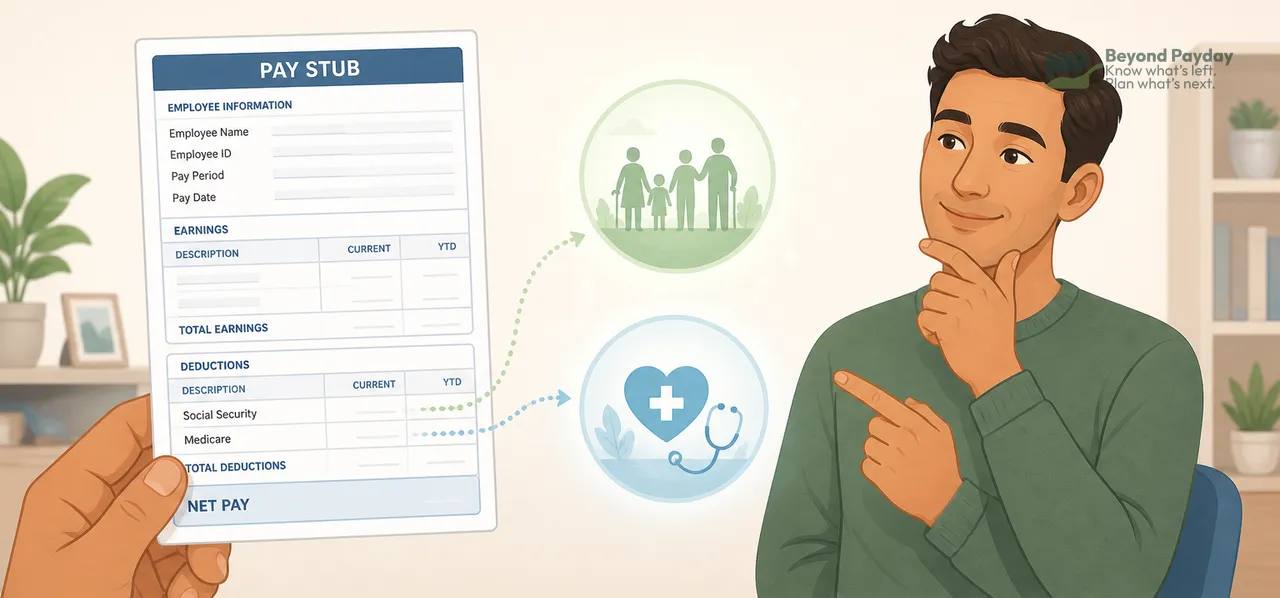
Look at almost any pay stub and you'll find a line labeled FICA, usually broken into two pieces. It's not a mistake, and it's not the same thing as your federal income tax withholding. It's a separate, mandatory payroll tax that funds Social Security and Medicare — and understanding it explains a lot about why your take-home pay looks the way it does.
- FICA is not income tax. It's a dedicated payroll tax that funds Social Security ( OASDI ) and Medicare, calculated separately from the federal income tax withheld from your paycheck.
- It's split between you and your employer. Each pays a matching share; a self-employed person effectively pays both shares.
- Social Security tax has an annual cap; Medicare does not. Earnings above a yearly limit called the wage base stop being taxed for Social Security — $184,500 in 2026, per the Social Security Administration — but every dollar keeps getting taxed for Medicare.
- Higher earners pay an extra 0.9% Medicare tax on wages above $200,000 ($250,000 for married couples filing jointly), on top of the standard rate.
- FICA applies from the first dollar earned, which is why a low-income worker can legitimately owe no federal income tax and still see a meaningful FICA deduction every pay period.
What FICA actually stands for and what it pays for
FICA is short for the Federal Insurance Contributions Act, the law that created this payroll tax. It funds two specific federal programs, and per the IRS, it's withheld from wages alongside — but separately from — federal income tax:
- Social Security (OASDI): retirement benefits, disability benefits, and survivor benefits for eligible workers and their families.
- Medicare: hospital insurance and related health coverage, primarily for people age 65 and older and some younger people with qualifying disabilities.
Your pay stub might show "FICA" as one combined line, or it might split it into "Social Security" and "Medicare" (sometimes labeled OASDI and HI). Either way, it's the same underlying tax.
FICA vs. federal income tax: two completely different systems
These two deductions often sit right next to each other on a pay stub, which is exactly why people confuse them. They work nothing alike:
| Federal income tax | FICA | |
|---|---|---|
| What it funds | General federal spending | Social Security & Medicare specifically |
| How it's calculated | Graduated brackets based on taxable income, filing status, deductions | Flat percentage of wages, from dollar one |
| Can it be zero? | Yes, for many low or moderate earners after deductions and credits | No — it applies to essentially all wage income |
| Governed by | Form W-4 elections and IRS withholding rules (IRS) | Set statutory rates, not adjustable by the worker |
The IRS explains that federal income tax uses a graduated bracket structure, where a higher bracket applies only to the income above its threshold — and after subtracting deductions, some workers end up owing very little or nothing. FICA doesn't work that way at all; it's a flat rate applied to gross wages, with no equivalent to a standard deduction.

The employee and employer halves
FICA is designed as a shared cost. The IRS describes the structure this way, with the current-year rates published in IRS Publication 15:
- Employees have a share withheld directly from each paycheck — 6.2% of wages for Social Security and 1.45% for Medicare.
- Employers pay a matching share on the employee's behalf — the same 6.2% and 1.45% — which doesn't show up on the pay stub as a deduction because it isn't taken from the worker's wages.
That's 7.65% from you and another 7.65% from your employer — 15.3% of wages in total, roughly double what the stub shows. The rates are written into law and aren't indexed, so they rarely change; what moves every year is the Social Security wage base (below).
Self-employed workers pay both halves
If you're self-employed, there's no separate employer to split the cost with — you're both. This is generally handled through self-employment tax. The IRS describes it as combining both the employee and employer shares of Social Security and Medicare into one tax, paid directly by the self-employed person — typically through estimated tax payments rather than payroll withholding. Per IRS Topic 554:
- The rate is 15.3% (12.4% Social Security + 2.9% Medicare), once net self-employment earnings reach $400 for the year.
- It applies to 92.35% of net earnings, not 100% — a built-in adjustment that mirrors the fact that an employer's half isn't counted as an employee's wages.
- Half of it is deductible when calculating adjusted gross income, which softens (but doesn't erase) the double hit.
Note
This is one of the most common surprises for people moving from a W-2 job to freelance or 1099 work: nobody is quietly covering half of FICA for you anymore. The full combined rate now runs through your own tax return.
The Social Security cap — and why Medicare doesn't have one
Social Security tax only applies up to the wage base — a dollar limit on earnings subject to that portion of FICA. The Social Security Administration resets this limit every year, so:
- Earnings up to the wage base are taxed for Social Security at the standard rate.
- Earnings above the wage base in that same calendar year stop being taxed for Social Security — the withholding simply stops once you cross it.
- The 2026 wage base is $184,500, up from $176,100 in 2025 (SSA 2026 COLA fact sheet). That caps the employee's Social Security tax at $11,439 for the year (6.2% × $184,500). It resets every January.
- Two jobs can mean overpaying. Each employer withholds as if it's your only one, so combined Social Security withholding can blow past $11,439. The excess isn't lost — it's claimed as a credit on your federal return. (If a single employer over-withheld, that employer has to fix it, not the IRS.)
Medicare has no such cap. Every dollar of wage income, no matter how high, continues to be taxed for Medicare at the standard rate.
The Additional Medicare Tax
On top of the standard Medicare rate, an Additional Medicare Tax of 0.9% applies to wages above a threshold set by filing status (IRS Topic 560). There's no employer match on this piece, and unlike the wage base, the thresholds aren't indexed to inflation:
| Filing status | Additional Medicare Tax starts above |
|---|---|
| Married filing jointly | $250,000 |
| Married filing separately | $125,000 |
| Single, head of household, others | $200,000 |
Watch out
Your employer doesn't know your filing status. By law it starts withholding the extra 0.9% once your wages from that job pass $200,000, no matter how you file. So two spouses earning $150,000 each owe it on $50,000 of combined wages — but neither employer withholds a cent. The gap shows up at tax time.

Why FICA shows up even when income tax doesn't
This is the part that trips up a lot of workers, especially students, part-timers, and low-income earners:
- Federal income tax has a floor. After standard deductions and credits, many lower earners owe little or no federal income tax for the year.
- FICA has no floor. It applies as a flat percentage of wages starting with the very first dollar, with no equivalent deduction or exemption.
Key point
That's why someone can file a return, get every dollar of federal income tax withholding refunded, and still have paid a real amount in FICA over the course of the year — those two systems don't overlap or offset each other.
FICA isn't a mistake on a low earner's pay stub, and it isn't optional. It's simply a different tax with a different purpose than the income tax that's often the focus of tax-season conversations.
Who pays less (or no) FICA
FICA covers almost all wages, but there are real exceptions an expert would check first:
- Cafeteria-plan benefits. Health, dental, and vision premiums, HSA contributions, and FSA contributions run through an employer's Section 125 plan generally skip FICA as well as income tax (IRS Publication 15-B). Traditional 401(k) deferrals do not — they still count as FICA wages.
- Students working for their own school while enrolled and attending classes are generally exempt.
- Many nonresident students and scholars on F-1 or J-1 visas (common visa categories for international students and researchers) are exempt for a limited period.
- Some state and local government workers covered by a public pension plan instead of Social Security don't pay the Social Security portion (they usually still pay Medicare).
- Members of certain religious groups that oppose insurance (mainly self-employed members) can apply for an exemption, which also gives up the benefits.
What the money actually buys
Paying FICA builds eligibility for specific programs. What any one person receives depends on their full earnings history and the rules when they claim:
- Social Security retirement benefits — eligibility generally takes 40 work credits. In 2026 you earn one credit for each $1,890 of covered earnings, up to four a year (SSA 2026 COLA fact sheet).
- Social Security disability benefits — potential eligibility if a qualifying disability prevents work, based on sufficient work history.
- Survivor benefits — potential eligibility for a worker's spouse or dependents in the event of the worker's death.
- Medicare coverage — hospital insurance (Part A) generally starting at 65 or after qualifying disability; about 10 years of Medicare-taxed work usually makes Part A premium-free.
Note
About the "Social Security is running out" headlines: the 2026 Social Security Trustees Report projects the combined trust funds will be depleted in 2034 — at which point incoming payroll taxes would still cover about 83% of scheduled benefits unless Congress changes the law. "Depleted" means the reserve runs dry, not that FICA-funded benefits stop.
A worked example
Two illustrative single filers using 2026 rules, with no pre-tax benefits:
| Earns $50,000 | Earns $250,000 | |
|---|---|---|
| Social Security (6.2%, capped at $184,500) | $3,100 | $11,439 |
| Medicare (1.45%, no cap) | $725 | $3,625 |
| Additional Medicare (0.9% over $200,000) | $0 | $450 |
| Employee FICA for the year | $3,825 | $15,514 |
| FICA as a share of wages | 7.65% | ≈6.2% |
The employer pays another $3,825 and $15,064 respectively (it doesn't match the 0.9%).
The non-obvious takeaway: because of the wage base, FICA takes a smaller share of pay from the $250,000 earner than from the $50,000 earner — the opposite of how income tax works. And at $50,000, FICA can easily be a bigger line than federal income tax.
If untangling what's actually being deducted from your paycheck — FICA, income tax withholding, and everything else — feels like more math than you want to do by hand, a tool built to break down a paycheck line by line can make it easier to see where the money on your pay stub is really going.
FAQ
Is FICA the same as federal income tax?
No. FICA is a separate payroll tax that funds Social Security and Medicare, while federal income tax is a different tax based on your taxable income and filing situation, as described by the IRS.
Why do I have FICA withheld if I don't owe any federal income tax?
FICA is calculated as a flat percentage of wages from the first dollar earned, with no standard deduction or exemptions, so it applies even to earners whose income tax liability is reduced to zero.
Does Social Security tax stop at some point in the year?
Yes. The Social Security portion stops once your wages for the year pass the wage base ($184,500 in 2026, per the SSA), while Medicare has no cap.
Do self-employed people pay FICA?
Not through payroll — they pay self-employment tax instead. It's 15.3% on 92.35% of net self-employment earnings (both halves combined), and half of it is deductible, per the IRS.
What is the Additional Medicare Tax?
It's an extra 0.9% Medicare tax on wages above $200,000 (single), $250,000 (married filing jointly), or $125,000 (married filing separately), per the IRS. Employers start withholding it at $200,000 regardless of filing status, so the final amount is settled on your return.
Related reading

Why is my paycheck so much smaller than my salary?
Your salary is a yearly number; your paycheck is what's left after taxes and benefits come out of each pay period. Here's a line-by-line walk from gross pay to net pay, so nothing on your stub is a mystery.

W-2 vs 1099: what actually lands in your bank account
A $70,000 salary and a $70,000 1099 rate are not the same money. The surprise: after the 2026 tax math, the tax gap is small — it's the benefits that cost you.

Pre-tax vs post-tax payroll deductions: what's the difference?
A $200 pre-tax deduction doesn't cost you $200 of take-home pay — but it doesn't disappear from the IRS's radar forever either. Here's how each bucket actually works.
Beyond Payday is a planning tool, not a financial advisor. This article is educational — projections and examples are estimates, not financial, tax, or investment advice.