

Living paycheck to paycheck means every dollar coming in is already spoken for before the next one arrives — no cushion, no room for a surprise. Breaking the cycle usually isn't about willpower. It's a small cash buffer, a hard look at your three biggest expenses, and a few automated habits that keep progress from leaking back out.
- Living paycheck to paycheck is often driven by income, cost of living, or a past shock — not just spending habits, so don't assume it's purely a discipline problem.
- A small buffer ($500-$1,000) absorbs the small emergencies that otherwise restart the cycle.
- The big three — housing, transportation, food — move the needle far more than small recurring subscriptions.
- Small, automated wins (a $25/week auto-transfer) compound faster than most people expect.
- Getting ahead is often less about a single big fix and more about removing repeated small shocks.
Understand the actual root cause first
"Paycheck to paycheck" describes a symptom, not a single cause. The fix depends on which of these actually applies:
- Income is genuinely tight relative to the cost of living — no amount of trimming small expenses closes a large structural gap; the honest levers are increasing income, reducing the largest fixed costs, or both.
- One or two expenses are oversized for the income — often housing or a car payment taken on before an income drop, or a rate increase.
- Repeated small shocks keep resetting progress to zero — a car repair, a medical copay, a slightly-too-tight month — each one wipes out savings before it can build up.
- Spending drifts to match income even when income rises, so nothing ever gets ahead (sometimes called lifestyle creep).
Note
Most people are dealing with some combination of these, not just one. Being honest about which apply changes where the effort should go.
Build a small buffer first — before anything else
A cash buffer is usually the single highest-leverage first move, because it interrupts the mechanism that keeps resetting people to zero.
- Target $500-$1,000 to start — enough for a car repair or a medical copay, small enough to build relatively quickly.
- Fund it in a short sprint if possible: pause non-essential spending for a defined stretch (a few weeks to a couple months) and direct every spare dollar there.
- Route windfalls there too — a tax refund, a bonus, cash gifts — until the target is hit.
- Keep it in a separate, easy-to-reach account so it's used for its actual purpose, not blended into everyday spending.
Once the starter buffer exists, a longer-term emergency fund (commonly 3-6 months of expenses) becomes the next target, but the small buffer is what stops the immediate bleeding.
Attack the big three expenses first
Housing
- Consider a roommate, a smaller unit, or renegotiating rent at renewal
- Refinancing a mortgage when rates allow
- Moving isn't always realistic short-term, but it's often the single largest lever available
Transportation
- Compare the true cost of a car payment plus insurance plus maintenance against alternatives
- Refinancing an auto loan if the rate is high relative to current rates
- Insurance shopping every 1-2 years, since rates change without notice
Food is the third big lever — not eliminating it, but noticing the gap between a grocery-heavy plan and a takeout-heavy one, which is often the largest gap in a household's control.
Small recurring costs (streaming subscriptions, memberships) are worth trimming too, but they rarely close a gap the way the big three can — start with whichever expense is actually largest.
Bank small, automated wins
Big structural fixes (moving, refinancing) take time. Small automated habits work in parallel and compound faster than they feel like they should.
- A recurring $20-$50/week auto-transfer to savings, timed to payday, adds up to $1,000-$2,600 a year without a single manual decision.
- Auto-escalate a savings transfer slightly every time a bill is paid off or income rises, so the extra room doesn't just get absorbed into spending.
- Round-up or spare-change style saving, if available through your bank, adds a small but steady amount with zero ongoing effort.
Tip
The mechanism that works is removing the decision. A transfer that has to be manually made every week gets skipped during a busy or stressful month — an automatic one doesn't.
The mindset shift that sticks
- Progress isn't linear. A month with a car repair doesn't erase months of progress before it — the buffer existing is what prevents that.
- "Getting ahead" starts small. The first $500 buffer feels disproportionately significant because it's the first time a surprise expense doesn't force a scramble.
- Comparing to others rarely helps. Cost of living, income, and family obligations vary enormously; the only useful comparison is your own trend over time.
An example with real numbers
An illustrative walkthrough — not a recommendation:
A household bringing home $3,800/month finds they're consistently $100-$200 short before payday. They:
- Pause discretionary spending for six weeks and redirect roughly $600 total plus a $400 tax refund into a buffer account, reaching $1,000.
- Shop auto insurance at renewal and find a policy $35/month cheaper — a permanent, automated win with zero ongoing effort.
- Set up a $30/week auto-transfer to savings starting the week after the buffer sprint ends, timed to land right after payday.
- Six months later, the $1,000 buffer has absorbed one $300 car repair and one $150 medical bill without a single missed payment or new credit card balance, and roughly $780 has accumulated in ongoing automated savings on top of it.
FAQ
How much of a buffer do I need to stop living paycheck to paycheck?
Even $500-$1,000 covers most small emergencies (a car repair, a medical copay) that would otherwise force a credit card charge or a missed bill.
What's the fastest way to build a starter buffer?
A common approach is a short, focused sprint — pausing discretionary spending and directing every spare dollar and any windfalls to the buffer until it hits its target, then easing back.
Is living paycheck to paycheck only about spending too much?
No. Income level, cost of living, and one-time shocks (medical bills, job loss, an inflation spike) are frequently the real driver, not just discretionary spending habits.
Should I cut small expenses like coffee first?
Small recurring costs add up but rarely move the needle as much as the big three — housing, transportation, and food. Start with whichever expense is largest before targeting small ones.
How long does it usually take to break the cycle?
It varies widely by income and expenses, but many people notice real breathing room within a few months of building even a small buffer and trimming one or two big costs.
Sources and context
These primary publications explain the data and concepts identified below. Survey results and historical examples describe their stated populations and periods; they do not predict an individual outcome.
- CFPB: Your Money, Your Goals toolkit
Income and spending trackers, cash-flow budgeting, and prioritizing bills when money is short.
- CFPB: building an emergency fund
Emergency savings, common unexpected expenses, and why the appropriate reserve depends on the household.
Related reading

How big should your emergency fund be?
The standard rule is 3–6 months of essential expenses, but the right number depends on how stable your income and job actually are.

How to make a budget that actually works
A budget only works if it matches your real income, splits fixed from variable costs, and runs on autopilot. Here's the step-by-step process.
The 50/30/20 budget rule, explained
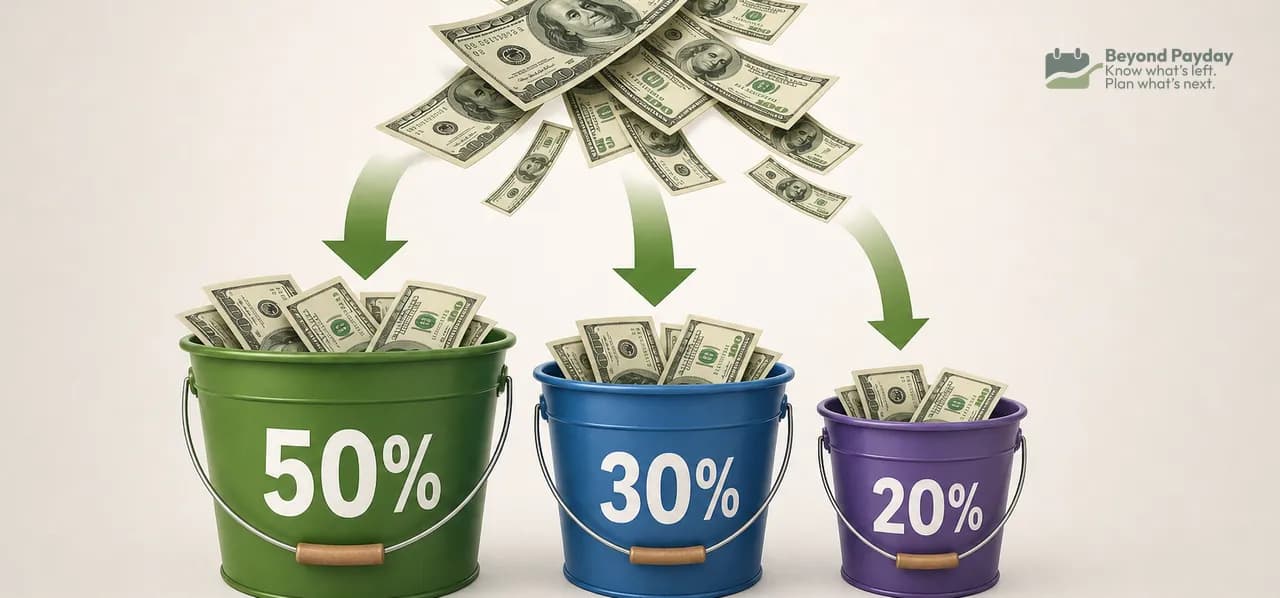
The 50/30/20 rule splits your take-home pay into needs, wants, and savings. Here's exactly how the math works, a full example, and where the rule breaks down.
Beyond Payday is a planning tool, not a financial advisor. This article is educational — projections and examples are estimates, not financial, tax, or investment advice.