

A real deal is a lower price than an item usually sells for, on something you already meant to buy. A fake discount measures the sale price against a "was" price the item rarely or never sold at. The quickest test: ignore the percentage, look at what the item has actually cost over the past few months, and ask whether it was on your list before you saw the ad.
- The percentage off is only as honest as the "was" price. The seller picks that starting number.
- Federal guidance says a former price should be real. The FTC's pricing guides say it should have been offered openly, in good faith, for a reasonably substantial period.
- "On sale" is often the normal price. A 2025 study found 21 of 25 national chains showed sale prices more than half the time.
- Price history beats the price tag. A few minutes with a price-history tracker tells you more than any banner.
- A deal on something you didn't plan to buy is new spending, not savings.
Why "40% off" can mean almost nothing
The discount is measured from a number the seller chooses. If that number is inflated, the percentage is too.
- What a fair "was" price looks like. The FTC's Guides Against Deceptive Pricing say a former price should be one the item was offered at openly, in good faith, for a reasonably substantial period. A price set up mainly to make a cut look big is what the guides call fictitious.
- "Compare at" and list prices have the same problem. The guides on manufacturer's suggested prices say a discount from a list price can mislead when hardly anyone in the area actually charges that list price.
- Permanent sales are common. Consumers' Checkbook, a nonprofit consumer group, tracked prices weekly for 24 weeks in 2025 at 25 national chains. It found 21 of the 25 advertised sale prices more than half the time, up from 6 in its 2018 study. When an item is "on sale" most weeks, the sale price is the real price.
- Your brain grabs the first number it sees. Psychologists call this anchoring. Tversky and Kahneman described it in a 1974 paper in Science. A big crossed-out price is an anchor.
Key point
The question isn't "how much off?" It's "how much less than this item normally costs, and did I need it anyway?"
Seven discount tricks and how to spot them
Most misleading deals follow a few patterns. Once you know them, they're easy to notice.
| What you see | What it can really mean | Quick check |
|---|---|---|
| "Was $199, now $119" | The $199 price lasted a week, or never sold | Look up the item's price history |
| "Compare at" or "MSRP" | A reference price few stores charge | Check what other big sellers charge today |
| "Up to 70% off" | Only a handful of items hit the top number | Look at the discount on the item you want |
| Countdown timer | The offer may not end when the clock does | The FTC has flagged timers on offers that aren't really time-limited |
| Bundle "value" | Extras you'd never buy priced at full retail | Price only the part you want |
| "Free shipping" | A minimum spend that pulls you past your budget | Compare the total with shipping on a smaller cart |
| Member or card-only price | A fee or card sign-up hiding inside the deal | Add the fee to the price |
How to check a price in about three minutes
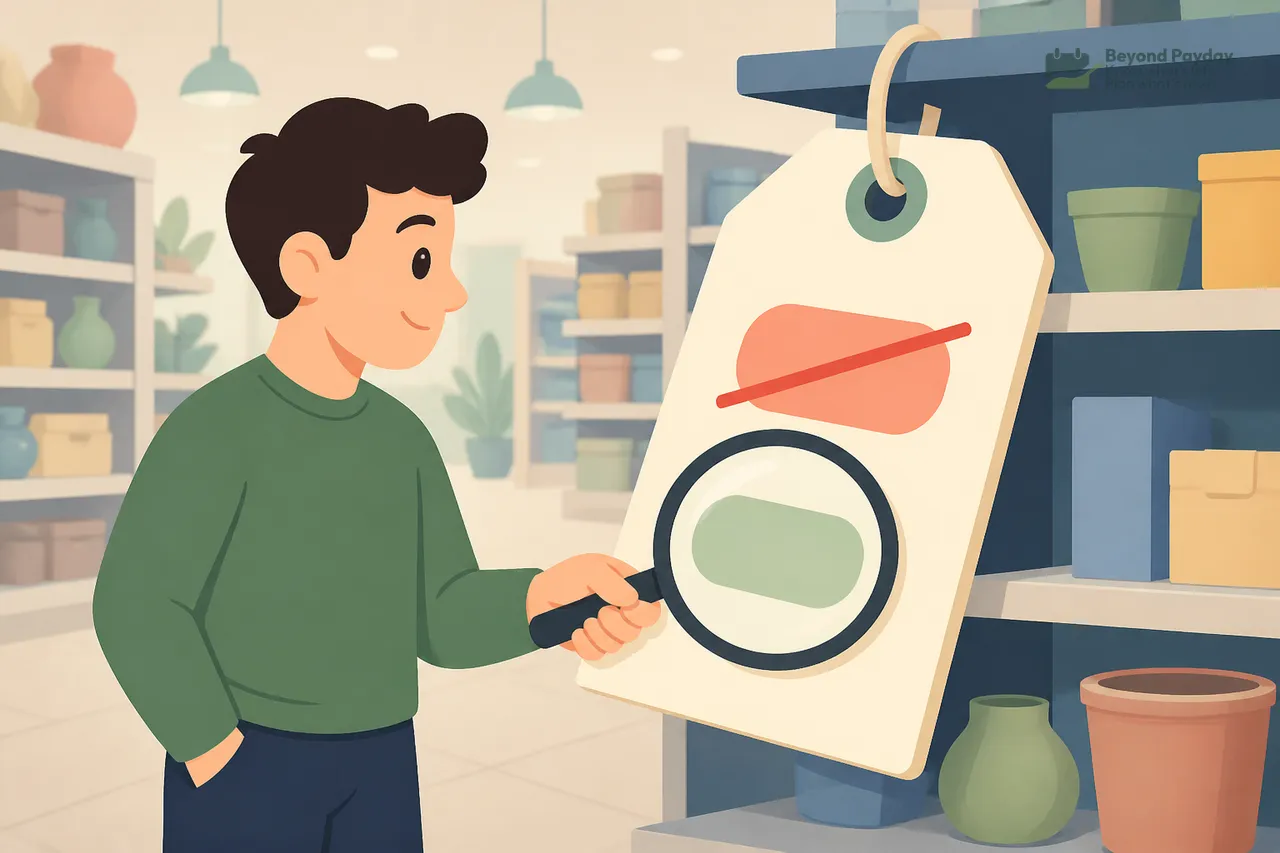
Treat the sale price as a claim to verify. A short routine catches most fake discounts.
- Write down the exact model number. The FTC's online shopping guide suggests noting the maker, model number, size and color before you compare.
- Look at the price history. Price-history trackers chart what an item has cost over weeks or months. Look for the typical price, not the highest one.
- Compare the total, not the sticker. Shipping, tax, membership fees and return costs all count. The FTC suggests working out the total cost, including shipping, handling, taxes and other fees.
- Compare like with like. Same model, same size, same storage, same condition (new vs. open-box vs. refurbished).
- Use the unit price for things you use up. Price per ounce or per count shows whether a "value pack" is a better deal.
Tip
"Lowest price ever" isn't always the best clue. Checkbook found some stores' prices for the same item swung by as much as 100% over several months. The more a price bounces, the more the typical price matters.
The deal on something you didn't plan to buy
Saving 40% on something you weren't going to buy isn't saving 40%. It's spending 60%. This is the most expensive trap of the season, and it works on careful shoppers too.
- "Saved" money only counts if it stays in your account. Spending $60 on a $100 item you didn't plan to buy leaves you $60 poorer, not $40 richer.
- Sale events set the calendar. In the National Retail Federation's October 2026 holiday survey, 64% of shoppers said they were likely to do most of their shopping over Thanksgiving weekend.
- A list made before the ads beats a list made from the ads. Writing down what you need, and a top price for each item, gives you something to compare deals against.
Four questions some shoppers use before clicking buy:
- Would I buy this at this price on an ordinary day in March?
- Was it on my list before I saw the ad?
- What does it cost per use? A $90 coat worn 100 times costs 90 cents a wear. A $30 gadget used twice costs $15 a use.
- How many hours of work is it? Divide the price by your hourly take-home pay (after taxes, not your gross wage).

Planned vs. unplanned, in numbers (example)
- Planned: a $300 vacuum you need, found for $240. You spent $60 less than planned.
- Unplanned: a $200 smartwatch "deal" at $120. You spent $120 you hadn't planned to.
- Net effect: $60 more spent overall, though both looked like savings.
Price adjustments and returns: your safety nets
A store's price-adjustment and return rules can matter more than the sale itself. They're easiest to check before you buy, not after the price drops.
- Price adjustment. Some stores refund the difference if their own price drops within a set window after you buy. Check the window length and whether sale, doorbuster, clearance or marketplace items are excluded.
- Price matching. Some sellers match a competitor's price or their own online price. The FTC suggests checking whether a seller has a price-matching policy.
- Return window. Ask when the clock starts (purchase date, delivery date or a holiday date). Gifts bought in November can run out of return time before they're opened.
- Return costs. The FTC lists the questions to ask: can you get a full refund, will you pay a restocking fee, and who pays return shipping. It also notes sale items often have different return rules.
- How you pay. Paying by credit card gives you a way to dispute certain charges. The FTC says a written dispute needs to reach the card company within 60 days of the date the first bill showing the error was mailed.
Watch out
"Final sale" usually means no returns and no adjustments. A fake discount on a final-sale item is the worst combination: no way to get the money back if the price drops or the item disappoints.
When a "deal" costs more than full price
A discount paid for with interest can shrink fast. It's an easy cost to overlook.
- The average interest rate on credit card accounts that were charged interest was 22.36% in the third quarter of 2026, according to the Federal Reserve.
- Example: a $500 item at 25% off costs $375. Paid off in equal monthly payments over 12 months at 22.36%, the interest comes to about $47. Over 24 months, about $94.
- The "25% off" has become about 16% off after one year, and closer to 6% off after two.
- If the item wasn't planned, every dollar of that interest is new cost.
How the same sale looks to different shoppers
| Your situation | The real deal | The trap to watch |
|---|---|---|
| Replacing something broken | Waiting for a known sale on an item you must buy anyway | Upgrading to a pricier model because it's "on sale" |
| Parent buying kids' gifts | Buying from a list made with the kids' wish lists | Bundles and "extra" toys added to reach a discount tier |
| Couple sharing money | Agreeing on a spending cap before the sales start | Two people each buying "a great deal" for the house |
| Carrying a card balance | Planned buys you can pay off by the statement due date | Discounts that end up costing interest for months |
| Tight monthly budget | Skipping the event entirely if nothing on the list is cheaper | "Free shipping" minimums that add items |

An example: checking one "40% off" tag
Here's how the three-minute check plays out on a TV (an illustration, not a real listing):
- The ad: "Was $499, now $299. Save 40%."
- Price history: The TV sold for $329 for most of the fall, and dropped to $299 twice before.
- Other stores: Two large sellers list the same model at $319 and $299.
- Real saving compared with the usual price: $30, about 9%, not $200.
- What it shows: a fair price, not a rare one. On a planned purchase, that's a modest saving. On an unplanned one, it's $299 of new spending.
Key point
Before-you-buy checklist: on my list? · checked price history? · compared total cost? · know the return and price-adjustment rules? · can pay it off before interest starts?
Holiday sales come back every year. A list, a top price for each item, and a price-history check make each one easier to judge.
FAQ
Is it legal for stores to show a fake "was" price?
The FTC's Guides Against Deceptive Pricing say a former price should be one the item was openly offered at, in good faith, for a reasonably substantial period. A price inflated mainly to make a discount look bigger is what the guides call fictitious.
Are Black Friday prices the lowest of the year?
Not reliably. A 2025 Consumers' Checkbook study found most of the 25 national chains it tracked showed "sale" prices more than half the time, so the item's price history is a better guide than the date.
What is a price-history tracker?
It's a website or browser extension that records what an item has cost at a store over time. It shows the typical price, so you can compare it with the advertised "was" price.
What is a price adjustment?
Some stores refund the difference if their own price drops within a set number of days after you buy. Windows and exclusions vary by store, so the policy is worth reading before you buy.
Does paying by credit card help if a purchase goes wrong?
Credit cards come with federal billing-dispute rights. The FTC says a written dispute generally needs to reach the card company within 60 days of the date the first bill showing the error was mailed.
Related reading
Where does your money go? How to track your spending
You can't fix a budget you can't see. Here's how to track spending manually or automatically, sort it into categories that mean something, and actually use the review.

What is a sinking fund? The budget line most plans miss
Sinking funds are small monthly deposits set aside for expenses you know are coming — like car registration or holiday gifts — so they never blow up your budget again.

How to make a budget that actually works
A budget only works if it matches your real income, splits fixed from variable costs, and runs on autopilot. Here's the step-by-step process.
Beyond Payday is a planning tool, not a financial advisor. This article is educational. Projections and examples are estimates, not financial, tax, or investment advice.