
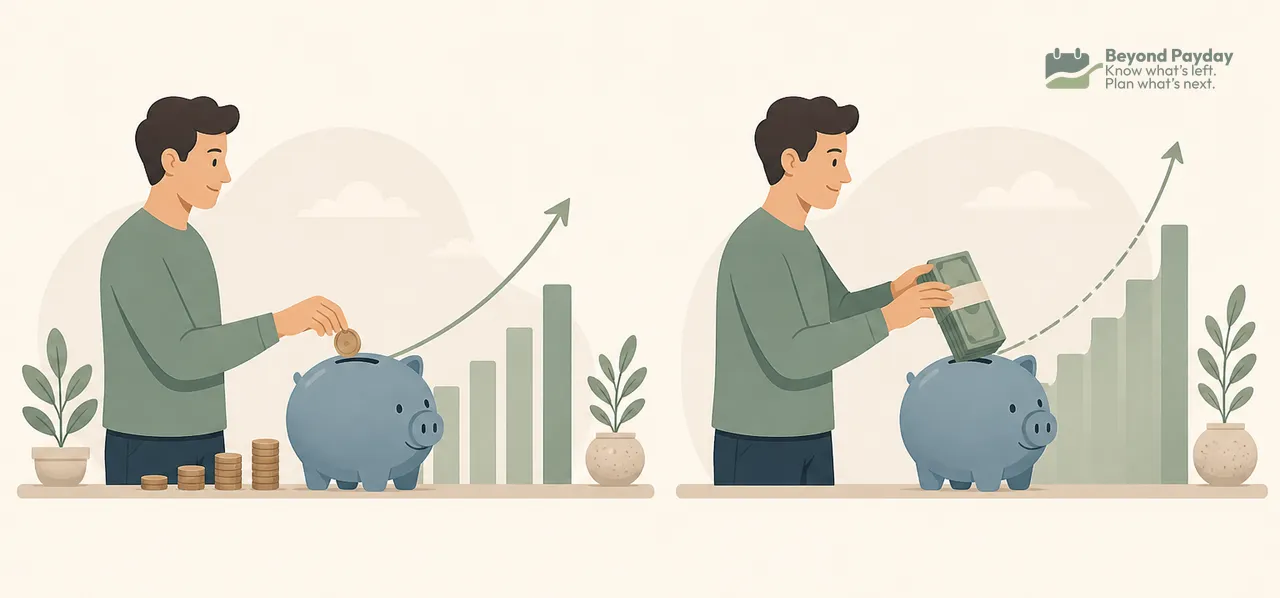
If you have a lump sum sitting in cash — a bonus, an inheritance, savings you've finally decided to invest — you have two basic choices: put it all into the market now, or spread it out over time. Historically, investing it all at once has come out ahead about two-thirds of the time, because markets have spent more time rising than falling. But spreading it out cuts the odds of a painful drop right after you invest, and it's often easier to actually follow through on. They're optimizing for different things.
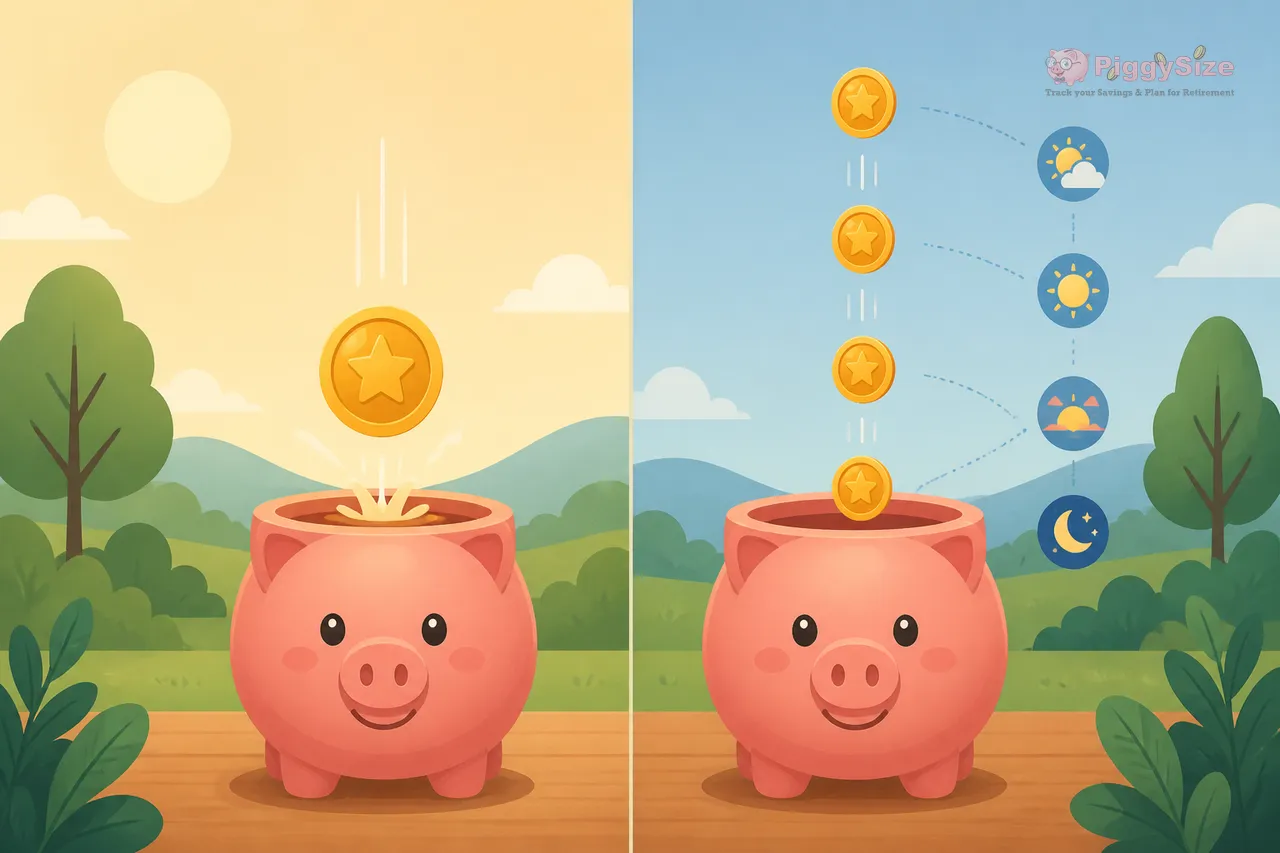
- Dollar-cost averaging means splitting a lump sum into smaller amounts invested on a set schedule instead of all at once.
- In Vanguard's research, investing the lump sum immediately beat spreading it out roughly two-thirds of the time.
- The longer you stretch the schedule, the bigger the expected cost, because more money sits in cash for longer.
- Spreading it out shrinks the worst-case, "invested the day before a crash" outcome — and that can matter as much as the math if it keeps you from panic-selling.
- The real loser in the research is neither strategy: it's leaving the money in cash indefinitely while you wait for a "better" moment.
- Investing from each paycheck is a different situation — that money doesn't exist yet as a lump sum.
What dollar-cost averaging actually means
Dollar-cost averaging (DCA) is a way of investing a specific amount of money you already have — not a description of regular saving out of income.
Example of DCA:
- You have $12,000 to invest.
- Instead of investing it all today, you invest $1,000 on the same day each month for 12 months.
- Each installment buys at whatever price exists that month — sometimes higher, sometimes lower — which averages your purchase price over the year.
The alternative — lump-sum investing — means investing the full $12,000 on day one.
What the research found: lump sum usually came out ahead
The case for investing immediately comes down to time in the market. Stocks and bonds have historically earned more than cash, so every month money waits on the sidelines is a month it's likely earning less.
Two Vanguard studies put numbers on it:
- Vanguard's 2012 study ("Dollar-cost averaging just means taking risk later") compared investing all at once against spreading it over 12 months, in a 60% stock / 40% bond portfolio, across rolling 10-year periods in the US (1926–2011), UK and Australia. Lump sum came out ahead in about 67% of periods in all three markets. In the US, it ended with about 2.3% more money on average.
- Vanguard's 2023 follow-up ("Cost averaging: Invest now or temporarily hold your cash?") used a shorter, three-month schedule, measured one year out, for a global stock portfolio from 1976–2022. Lump sum still won 68% of the time — and its win rate climbed as the schedule stretched from three months to six.
- The same 2023 study found spreading it out still beat sitting in cash about 69% of the time. If the real choice is DCA or "wait until the market feels safe," the research favors DCA.
Note
"About two-thirds" is doing real work there. It means lump sum lost in roughly one of every three historical periods — usually the ones where a decline hit right after the money went in.
The honest case for spreading it out
DCA exists because avoiding the worst-case outcome has real value, even if it costs some expected return. Vanguard's 2023 paper makes this point itself: in the worst historical market environments, spreading it out left investors with more money after a year.
- Reduces "bad timing" risk. Invest everything right before a sharp decline and the whole sum takes the hit. Spread it out and only part of it does.
- Smooths your entry price. You buy at a mix of higher and lower prices instead of betting everything on one day's price.
- Makes it easier to start. For many people the real risk isn't lump sum vs. DCA — it's investing nothing because committing a big sum at once feels too scary.
- Limits regret. Watching a lump sum drop 10% in its first month is a vivid kind of pain that pushes people to sell at a loss or stop investing for years.
Tip
Regret isn't a character flaw — it's a real cost. A plan you can stick with through a downturn often beats a higher-expected-value plan you'd abandon under stress.
Lump sum vs. DCA, side by side
| Lump sum (invest all now) | Dollar-cost averaging (spread it out) | |
|---|---|---|
| Time in market | Maximized from day one | Builds up over the schedule |
| Historical odds of a higher ending balance | About 2 in 3 periods (Vanguard 2012, 2023) | About 1 in 3 periods |
| Exposure to a near-term drop | Full amount exposed immediately | Only the invested portion exposed |
| Emotional experience | Can feel high-stakes on day one | Feels more gradual and controllable |
| Uninvested cash while waiting | None | Sits in cash, exposed to inflation and lower expected growth |
| Often used for | Money that can stay invested for years | Money you have but aren't ready to commit all at once |
Paycheck investing isn't the same decision
This is where a lot of confusion creeps in. If a slice of every paycheck goes into a 401(k) or brokerage account, that isn't dollar-cost averaging as a deliberate choice — it's investing money as it arrives, because you don't have next month's paycheck yet.
- DCA is a choice about a sum you already have — you could invest it all now, and you're choosing not to.
- Paycheck investing happens because the money doesn't exist yet. There's no "invest it all at once" option for income you haven't earned.
- The lump-sum research is about money sitting in cash right now — a bonus, a home sale, years of built-up savings — not about whether to keep contributing from your paycheck.
That's why the claim sometimes floated online — that regular 401(k) contributions are "suboptimal" — misses the point. You can't lump-sum a career's worth of earnings on day one.

Common mistakes and edge cases
- Treating DCA as risk-free. It reduces timing risk on the invested portion, but the waiting cash loses ground to inflation and misses growth the whole time.
- Stretching the schedule too long. Spreading $10,000 over five years leaves most of it in cash for years. In Vanguard's 2023 data, the lump-sum win rate rose with each month added to the schedule (from three months to six); people who use DCA commonly use a window of a few months to a year.
- Parking the waiting cash at 0%. Vanguard's 2023 base case assumed the uninvested cash earned nothing. Cash waiting in a high-yield savings account or money market fund narrows the gap — Even so, Vanguard found lump sum still won about 65% of the time for an all-stock portfolio when the waiting cash earned Treasury-bill rates.
- Using money you'll need soon. Money needed within a few years carries different considerations than money meant to stay invested for decades. Time horizon matters more than entry timing.
- Obsessing over timing and ignoring the mix. What the lump sum goes into — the split between stocks, bonds and cash — shapes your risk far more than which month it goes in.
- Forgetting it's a spectrum. Investing half now and spreading the rest over a few months is a common middle path.
- Ignoring taxes on the way in. If the lump sum comes from selling something — a house, company stock, an inherited account — the tax bill can matter more than the timing question. That's worth a conversation with a CPA.
A worked example
Illustrative numbers, simplified to show the mechanics.
Assumptions:
- $12,000 to invest.
- Scenario A: all of it on day one.
- Scenario B: twelve $1,000 installments, one at the start of each month.
- The market rises smoothly by 8% over the year, with no dips (unrealistic, but it isolates the timing effect).
Result:
- Scenario A: $12,000 × 1.08 = $12,960.
- Scenario B: the first $1,000 gets the full year of growth, the last gets one month. Total: about $12,510.
- The gap: about $450, simply because Scenario B's money spent, on average, about half the year in cash.
Flip the assumption and the result flips too: if the market fell 8% smoothly, Scenario B would end ahead, because its later installments bought at lower prices. That's the whole trade-off in one line — DCA gives up some upside in rising markets in exchange for a softer landing in falling ones. Real markets zigzag, which is why the historical win rate is about two-thirds, not 100%.
FAQ
Is dollar-cost averaging a bad strategy?
It isn't bad — it's a tradeoff. In Vanguard's 2012 and 2023 studies, investing a lump sum at once beat spreading it out about two-thirds of the time, but spreading it out softened the worst outcomes and still beat sitting in cash most of the time.
What should I do with a large windfall, like an inheritance?
This is a personal decision that depends on your risk tolerance, time horizon, and other financial obligations, and many people talk it through with a financial advisor or CPA.
Does dollar-cost averaging actually reduce risk, or just delay it?
It reduces the risk of a large, immediate drop right after you invest, but the money you haven't invested yet is still exposed to inflation and opportunity cost, so it shifts risk rather than eliminating it.
Is investing part of every paycheck the same thing as dollar-cost averaging?
Not exactly — dollar-cost averaging is a choice you make about a sum of money you already have, while paycheck-based investing usually just reflects money being invested as it's earned, since it doesn't exist yet to invest all at once.
How long should a dollar-cost-averaging schedule last?
There's no fixed rule; many people who use it spread a sum over a few months to a year. Vanguard's research found that the longer the schedule, the larger the expected cost compared with investing all at once.
Related reading

How compound growth actually works, in plain numbers
Compound growth means your returns start earning their own returns. Here's what that looks like over 10, 20, and 30 years — and why starting early usually matters more than starting big.

Index funds vs. picking individual stocks: the trade-offs
Index funds and stock picking differ in diversification, cost, taxes, and effort — and the long-run data on who beats the market is surprisingly lopsided. Here's how each one actually works.
What is asset allocation, and why does it shift over time?
Asset allocation is the mix of stocks, bonds, and cash in a portfolio — and it’s widely treated as one of the first decisions in building a portfolio. Here's how it works, why it drifts, and why age-based rules of thumb conflict with each other.
Beyond Payday is a planning tool, not a financial advisor. This article is educational — projections and examples are estimates, not financial, tax, or investment advice.