
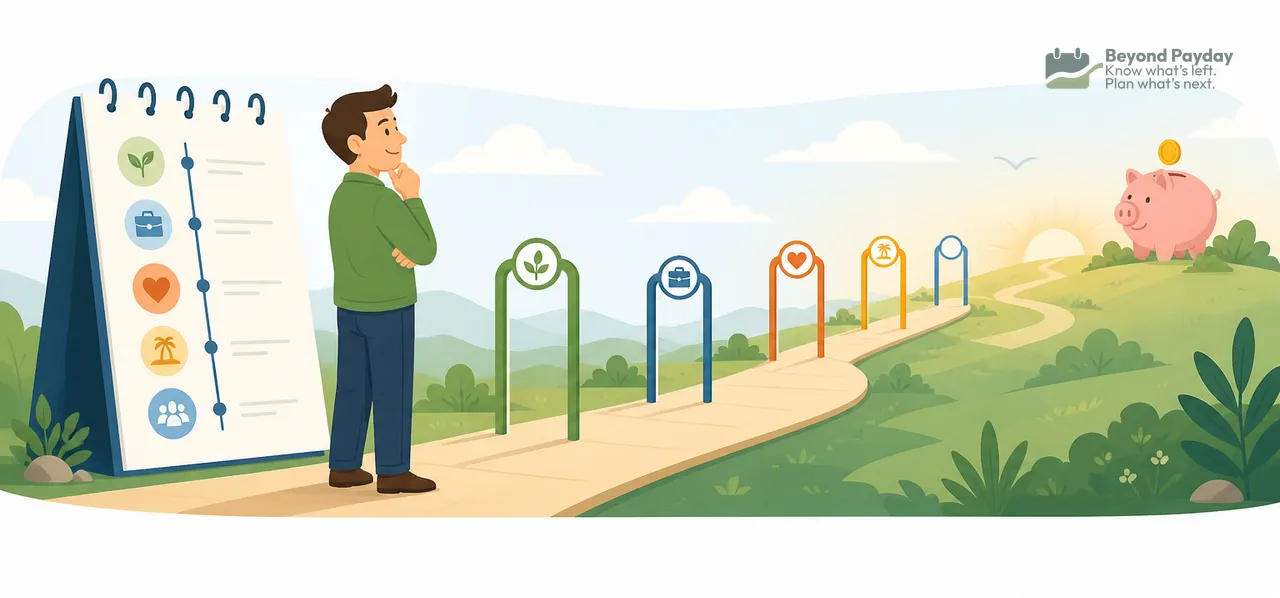
A required minimum distribution (RMD) is the smallest amount the IRS requires you to withdraw each year from certain tax-deferred retirement accounts once you reach a set age. It exists because the government eventually wants the taxes it let you defer — RMDs turn a tax-deferred account into taxable income, one withdrawal at a time.
- Traditional IRAs, 401(k)s, 403(b)s, and 457(b)s require RMDs during the owner's life; Roth IRAs never do, and since 2024, Roth 401(k)s and Roth 403(b)s no longer do either under SECURE 2.0.
- The starting age depends on birth year: 73 for people born 1951–1959, 75 for 1960 or later.
- The RMD is the prior December 31 balance divided by an IRS life-expectancy factor — about 4.1% of the balance at age 75, and the percentage climbs every year.
- Missing an RMD triggers a 25% excise tax on the shortfall, cut to 10% if it's corrected within two years.
- IRAs can be combined for RMD purposes, and so can 403(b)s with each other; 401(k)s cannot — each plan pays out its own.
Which accounts have RMDs — and which don't
Whether an account has RMDs depends on its tax treatment, not just its name.
RMDs required during the owner's life:
- Traditional IRAs, including rollover IRAs
- SEP and SIMPLE IRAs
- Traditional 401(k)s
- 403(b) and 457(b) plans
No RMDs during the owner's life:
- Roth IRAs — never have, at any age
- Roth 401(k)s and other designated Roth accounts in employer plans — no lifetime RMDs starting in 2024, a SECURE 2.0 change (IRS)
That difference is big: money in a Roth can keep growing untouched for the original owner's whole life, while a traditional account has to start paying out — and generating taxable income — whether the money is needed or not.
When do RMDs start?
The age isn't one fixed number anymore. The SECURE Act (2019) and SECURE 2.0 Act (2022) pushed it back in stages:
| Born | RMDs begin at age |
|---|---|
| Before July 1, 1949 | 70½ |
| July 1, 1949 – 1950 | 72 |
| 1951 – 1959 | 73 |
| 1960 or later | 75 |
This reflects law as of 2026. Congress has changed the age twice since 2019, with a third step already scheduled, so confirming the current rule on IRS.gov before acting on it is worthwhile.
Note
Your starting age is set by your birth year. A later law change for younger people doesn't move it for you.
How an RMD is calculated
The formula is simple; the two inputs are the only moving parts:
RMD = prior December 31 account balance ÷ life-expectancy factor
- The balance is the account's value on December 31 of the previous year.
- The factor comes from an IRS table. Most owners use the Uniform Lifetime Table. A different table, with smaller RMDs, applies when a spouse more than 10 years younger is the sole beneficiary.
Uniform Lifetime Table factors (IRS Publication 590-B):
| Age | Factor | RMD as % of balance |
|---|---|---|
| 73 | 26.5 | 3.8% |
| 75 | 24.6 | 4.1% |
| 80 | 20.2 | 5.0% |
Illustrative example
A 75-year-old with a $500,000 traditional IRA balance on December 31 of the prior year:
- RMD = $500,000 ÷ 24.6 ≈ $20,325
That $20,325 is added to taxable income for the year. Because the factor shrinks every year, the required percentage keeps rising — which is why RMDs can grow even while the account shrinks.
The first-year deadline — and the two-RMDs trap
The first RMD comes with a special option and a common pitfall.
- Delay option: the first RMD can wait until April 1 of the year after you reach RMD age. Every later RMD is due by December 31.
- The trap: delaying the first one means the second is due that same December 31 — two taxable RMDs in one calendar year.
- Doubling up can push income into a higher bracket, make more Social Security benefits taxable, and raise Medicare premiums through IRMAA surcharges two years later.
For that reason, many planners suggest weighing the tax hit before using the April 1 delay, even though it's allowed.
Rules people trip over
- RMDs can't be rolled over. Money that satisfies an RMD can't go into another IRA or plan (IRS).
- The first dollars out count toward the RMD. In an RMD year, a withdrawal meant to be rolled over is treated as the RMD first, until the RMD is met.
- Withdrawals don't have to be cash. An RMD can be taken "in kind" — shares moved to a taxable account — and still count, valued on the date of transfer.
- Taking more than required doesn't carry forward. An extra withdrawal this year doesn't reduce next year's RMD.
Aggregating IRAs vs. 401(k)s
Mixing this up is one of the most common RMD mistakes. Per the IRS:
- IRAs (traditional, SEP, SIMPLE): calculate each account's RMD separately, then withdraw the total from any one or more of them.
- 403(b)s: same idea — calculate separately, then take the total from any of your 403(b) contracts.
- 401(k)s and 457(b)s: each plan's RMD must come out of that plan.
- No mixing across types or people. An IRA's RMD can't be satisfied from a 403(b), and spouses can't combine each other's accounts.
The still-working exception
Some people can delay RMDs from a current employer's plan.
- If you're still working for the company that sponsors your 401(k) or 403(b), RMDs from that plan can generally wait until the year you retire (IRS).
- It does not apply to 5% owners of the business.
- It does not apply to IRAs or to plans from former employers.
- Not every plan offers it — it depends on the plan document.
What happens if an RMD is missed
- A 25% excise tax applies to the amount that should have come out but didn't (IRS).
- It drops to 10% if the shortfall is withdrawn and corrected within two years.
- The fix is filed on Form 5329, where the IRS also allows a request to waive the tax for reasonable error if the missed amount has been taken.
SECURE 2.0 cut this from the old 50% penalty, so older summaries overstate it.
Watch out
RMD rules have changed several times since 2019. A rule of thumb that was accurate a few years ago — the starting age or the penalty rate — may no longer be current. For an actual return, confirm with the IRS or a tax professional.
Planning ideas people discuss around RMDs
These are strategies commonly discussed in retirement planning, not recommendations for any individual. A CPA or financial professional can weigh them against a specific set of accounts and goals.
- Qualified charitable distributions (QCDs): a qualified charitable distribution sends IRA money straight to a charity and can count toward the RMD without adding to taxable income. Two details many people miss: QCDs start at age 70½ — years before RMDs do — and they're allowed from IRAs only, not 401(k)s. The 2026 limit is $111,000 per person (IRS, indexed for inflation).
- Roth conversions before RMDs start: converting part of a traditional account in the years between retirement and RMD age means paying tax now in exchange for smaller future RMDs. Whether it pays off depends on current versus expected future tax brackets.
- Withdrawal order: the order of drawing from taxable, tax-deferred, and Roth accounts affects lifetime taxes and how RMDs stack with Social Security, which is why some retirees map it out years in advance.

A quick word on inherited accounts
Inherited-account rules are their own system, and they changed a lot under the SECURE Act.
- Most non-spouse heirs (like adult children) must empty an inherited IRA or 401(k) by the end of the 10th year after the owner's death.
- If the original owner had already started RMDs, the heir generally also has to take annual withdrawals in years 1–9, under final IRS regulations issued in 2024.
- Spouses, minor children, disabled or chronically ill heirs, and heirs close in age to the owner get more flexible options.
Because the details turn on who inherited and when the owner died, inherited accounts are worth working through with IRS guidance or a tax professional.
RMDs are one of the few retirement milestones with a hard deadline, which makes them worth planning for years before they start — not just the year they kick in.
FAQ
Do Roth IRAs have required minimum distributions?
No. Roth IRAs have no RMDs during the original owner's lifetime, though beneficiaries who inherit a Roth IRA generally do have distribution requirements.
Do Roth 401(k)s have RMDs?
Not anymore. Starting in 2024, SECURE 2.0 removed lifetime RMDs from designated Roth accounts in employer plans such as Roth 401(k)s and Roth 403(b)s.
Can I take my total RMD from just one IRA if I have several?
For IRAs, yes: you calculate each IRA's RMD separately but can take the total from any one or more of them, and the same works among 403(b)s. 401(k) and 457(b) RMDs must be taken separately from each plan.
What happens if I don't take my RMD on time?
The shortfall is subject to a 25% excise tax, reduced to 10% if it's corrected within two years. The correction is reported on Form 5329, where the IRS also allows a request to waive the tax for reasonable error.
Does the RMD age apply the same way to everyone?
No. SECURE 2.0 set different starting ages by birth year — 73 for people born 1951 through 1959 and 75 for those born in 1960 or later — so two people in the same household can have different RMD ages.
Related reading

How much should you have saved for retirement by age?
Widely cited benchmarks suggest saving roughly 1x your salary by 30, 3x by 40, 6x by 50, and 10x by 67 — but the number that actually matters most is your savings rate, not a single checkpoint.

Roth vs traditional: which retirement account is right for you?
The core trade-off is simple — pay tax now with a Roth, or pay tax later with a traditional account — but income limits, required withdrawals, and your future tax bracket all shape which one fits better.

What is a 401(k) and how does it work?
A 401(k) is an employer-sponsored account that lets you save for retirement straight from your paycheck, often with free matching money — here's exactly how contributions, matches, vesting, and taxes work.
Beyond Payday is a planning tool, not a financial advisor. This article is educational — projections and examples are estimates, not financial, tax, or investment advice.