


A side hustle that pays $30 an hour on the app can net less than half that once gas, upkeep, taxes, and the unpaid time around the work are counted — in the example below, it works out to about $13. The only way to know your real number is to track it: gross income minus costs minus tax, divided by all the hours it actually takes.
- Gross pay isn't profit. Supplies, platform fees, mileage, equipment, and software all come off the top before you see real money.
- Taxes take another cut. Nothing is withheld, and self-employment tax alone is about 14% of profit before income tax even starts.
- Unpaid time counts. Driving to a start zone, messaging customers, restocking, and bookkeeping are real hours that lower your true hourly rate even though they're unpaid.
- True hourly rate = after-tax profit ÷ total hours worked — not just the hours you were actively earning.
- A few months of simple tracking (separate account, logged hours, monthly totals) usually reveals more than obsessing over a single week.
Gross income vs. net profit
What the app shows you and what you actually keep are two different numbers.
- Gross income is what shows up as your earnings in an app or invoice total.
- Net profit is what's actually left over — and it's the number that tells you whether the hustle is worth the time.
Most people only ever look at gross income, because it's the number the app puts in front of them. Net profit takes a few extra steps, but it's the only honest measure.
Step 1: Add up every direct cost
Any cost that exists because of the hustle counts, even the small ones.
- Supplies and materials — inventory, ingredients, packaging, craft materials.
- Platform and payment processing fees — a cut taken by a marketplace, delivery app, or payment processor before the money reaches you.
- Mileage or vehicle costs — gas, extra maintenance, faster depreciation, and added insurance risk from business use of a personal car. For a new car, AAA puts fuel at about 17 cents a mile and maintenance, repairs, and tires at about 12 cents, before depreciation (AAA Your Driving Costs, 2026).
- Equipment — a camera, tools, a second monitor, a cooler bag — spread out over how long it's expected to last.
- Software and subscriptions — scheduling tools, design apps, a dedicated phone line or plan.
A lot of these are easy to forget because they're paid once, occasionally, or automatically — not every time a job comes in.
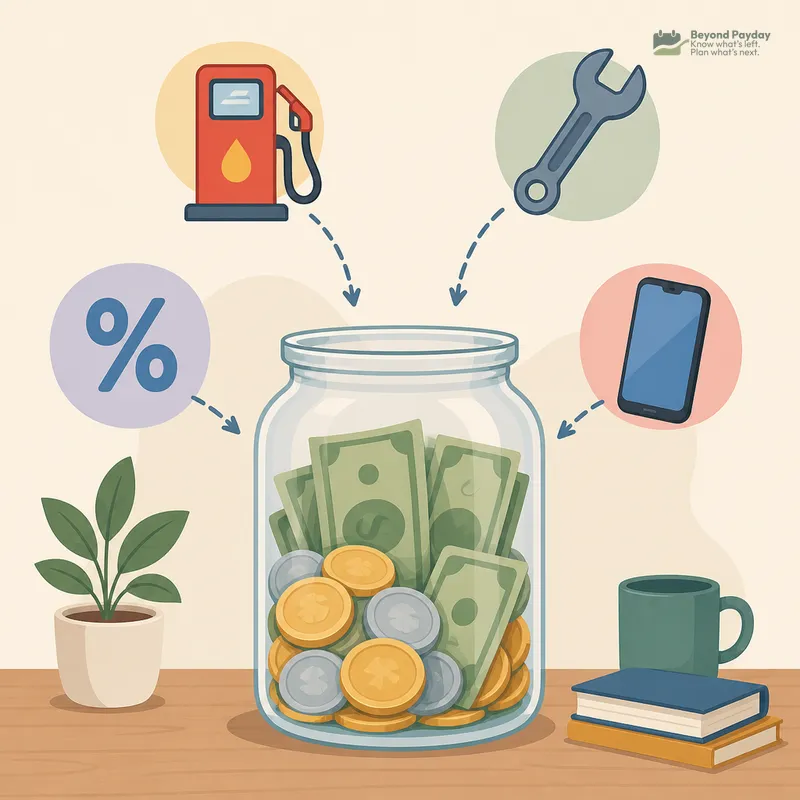
Step 2: Account for the tax that comes off the top
A paycheck from an employer has taxes withheld automatically. Side hustle income usually doesn't.
-
Income tax applies to self-employment earnings just like wages, under the same graduated bracket system — a bracket only applies to the income above its threshold, not to all income at that rate.
-
Self-employment tax applies on top of income tax: 15.3% on 92.35% of net profit — about 14.1% of each profit dollar — once net earnings reach $400 for the year, per IRS Topic 554.
-
Because nothing is withheld automatically, income without withholding can require quarterly estimated tax payments rather than one bill at filing time.
-
No form doesn't mean no tax. Apps generally only send a 1099-K above $20,000 and 200 transactions, but the IRS says all income must be reported either way (IRS: what gig workers should know).
-
Hobby or business? If the IRS views the activity as a hobby rather than a business run to make a profit, the income is still taxable but the expenses generally can't be deducted.
Many people with 1099 or gig income set aside a share of every payment as it comes in. The right percentage depends on total income, other jobs, filing status, and state — how much to set aside for 1099 taxes walks through the 2026 ranges.
Watch out
Self-employment tax is the cost people forget most often. It's easy to budget for income tax and miss the second tax that applies specifically to self-employment earnings — it can meaningfully shrink what a side hustle actually nets.
Step 3: Count all the time, not just the paid hours
This is where the real gap between "apparent" and "true" hourly rate usually hides.
- Active/paid time — the hours actually driving, crafting, coding, or delivering that generate the gross income figure.
- Unpaid time around the work — driving to a start zone, waiting between orders, replying to messages, restocking supplies, updating listings, and bookkeeping.
- True hourly rate is the number that reflects what the hustle actually pays per hour of a person's life, not per hour of active work.
A rate advertised as $30/hour almost always means active time only. In the example below, 5 unpaid hours on top of 15 paid ones turn $30 into $22.50 an hour before a single cost or tax is counted.
Opportunity cost: what else that time could be worth
- Opportunity cost doesn't show up in any spreadsheet, but it's part of a full picture.
- A true hourly rate that's lower than what a person could earn from other available options (like overtime at a main job) is a signal worth weighing, even when the hustle is otherwise enjoyable.
- A true hourly rate that's higher than the alternative, plus flexible timing, can make a hustle worth keeping even at a modest number.

A worked example: from $30/hour to a true hourly rate
Illustrative numbers, for one typical week.
Assumptions:
- 15 active hours of driving/delivering, paying a nominal $30/hour → gross pay of $450
- 5 additional unpaid hours for driving to a start zone, waiting, and messaging → 20 total hours
- 300 miles driven, at $0.29/mile for fuel, maintenance, and tires (AAA's 2026 new-car averages, excluding depreciation) → $87
- $5/week allocated for phone/data used for the work
- A tax set-aside of 25% of net profit (the right percentage depends on income, filing status, and state)
| Step | Amount |
|---|---|
| Nominal gross pay (15 active hrs × $30) | $450 |
| Minus direct costs (mileage + phone) | −$92 |
| Net profit before tax | $358 |
| Minus estimated tax set-aside (25%) | −$90 |
| After-tax profit | $268 |
| Total hours worked (active + unpaid) | 20 hours |
| True hourly rate ($268 ÷ 20) | about $13.40/hour |
Formula: true hourly rate = after-tax profit ÷ total hours worked (active + unpaid).
Tip
The tax bill is probably smaller than the set-aside — and that's not free money. The IRS standard mileage rate (72.5 cents a mile for January–June 2026, 76 cents from July 1, per the IRS) is built to cover depreciation too. So those 300 miles could be a deduction of roughly $218–$228, far more than the $87 of gas and upkeep. The difference is the car losing value, which gets paid later — at trade-in or replacement. Deducting mileage generally requires a log of business miles, kept as you go.
Limitations of this example: it leaves out depreciation, insurance changes, seasonal swings in demand, and the value of any non-money benefits — all of which could move the real number up or down.
How to track it without overcomplicating it
A full profit-and-loss spreadsheet isn't necessary to get a useful answer — a few simple habits over a few months usually do it.
- Use a separate account for hustle income and expenses, so the money isn't mixed with regular household spending and every deposit and cost is easy to find later.
- Log hours as they happen — active time and a rough estimate of admin/driving time — in a notes app or simple spreadsheet, rather than trying to reconstruct it later.
- Total it up monthly, not per shift. A single day or week can look great or terrible for reasons that have nothing to do with the hustle's real value.
- Track for at least a few months before drawing conclusions, since one strong or weak month rarely represents the average.
Seasonality can make one month lie
Many side hustles swing hard by season, and a single busy or slow stretch can distort the true picture.
- Delivery and rideshare often pick up around holidays and bad weather, then dip afterward.
- Craft or retail-style hustles frequently spike around gift-giving seasons and go quiet the rest of the year.
- Tutoring or seasonal services may follow a school calendar or a specific time of year entirely.
A true hourly rate calculated from the busiest month of the year will look better than the annual average — and a rate calculated from the slowest month will look worse. Averaging several months, or a full year if possible, gives a fairer number.
Non-money reasons people keep a hustle anyway
A modest true hourly rate doesn't automatically mean a side hustle isn't worth doing.
- Building a skill that's valuable for a future job or business, even if the current pay is unremarkable.
- Testing a path to full-time work, where the early stage is expected to pay less while a client base, audience, or reputation is built.
- Flexibility that fits around caregiving, another job, or unpredictable free time in a way a traditional job can't.
- Enjoyment — some people are simply willing to accept a lower true hourly rate for work they find satisfying or social.
None of these make the math disappear; they just mean the math isn't the only factor in the decision.
When growth costs more than it earns
Scaling up a hustle doesn't always increase profit at the same rate the effort increases.
- Extra equipment or inventory bought to grow the hustle adds cost immediately, while the extra revenue it enables may take time to catch up.
- Paid advertising or platform boosts can raise gross income while quietly lowering true hourly rate if the added sales barely cover the ad cost.
- Taking on help (a contractor, an assistant) adds a cost that has to be earned back before it improves anyone's hourly rate.
- Chasing every available hour on a platform can push a hustle into its slowest, least-paid time slots, since the best-paying hours are usually claimed first.
Comparing true hourly rate before and after a growth decision is one of the more reliable ways to tell whether an expansion actually helped.
Common mistakes
Watch out
- Ignoring wear on a personal vehicle. Gas is visible; the extra maintenance, tire wear, and faster depreciation from business mileage often aren't tracked at all.
- Forgetting self-employment tax. Budgeting only for income tax and being surprised by the added self-employment tax portion is one of the most common shortfalls people run into.
- Mixing hustle money with household spending. Without a separate account, it's nearly impossible to tell what the hustle actually nets versus what simply passed through a shared account.
- Counting only active hours. Admin, driving, and messaging time are real hours that belong in the denominator of a true hourly rate, not left out of it.
FAQ
Do I have to report side hustle income if it's small?
Generally yes — the IRS says all income must be reported, even if no 1099 arrives. Self-employment tax generally kicks in once net earnings reach $400 for the year (IRS Topic 554).
What counts as a deductible business expense for a side hustle?
The IRS standard is costs that are ordinary and necessary for the work, such as supplies, platform fees, and business mileage or equipment. A tax professional can help apply this to a specific situation, since recordkeeping rules matter.
Do I need to make quarterly estimated tax payments for side income?
The IRS generally expects estimated payments from people who will owe $1,000 or more when they file. Raising withholding at a W-2 job is a common alternative.
Is gas the only vehicle cost I should track?
No. AAA's 2026 figures put maintenance, repairs, and tires at about 12 cents a mile on top of roughly 17 cents for fuel, and depreciation is usually the biggest cost of all.
How often should I check whether a side hustle is still worth it?
Many people find monthly or quarterly reviews useful, since a single week can be misleading due to normal swings in demand, gas prices, or platform pay.
Related reading

How much should you set aside for taxes on 1099 income?
1099 and side-hustle income has no tax withheld, so federal, self-employment, and often state tax are on you. Here's the 2026 math behind the usual 20–35% set-aside.

How to budget on an irregular or variable income
Freelancers, commission earners, and gig workers can still budget with confidence. The key is budgeting off your lowest month, not your average.
Beyond Payday is a planning tool, not a financial advisor. This article is educational — projections and examples are estimates, not financial, tax, or investment advice.