

Most freelancers and side-hustlers land somewhere between roughly 20% and 35% of net profit for combined taxes. Self-employment tax alone takes about 14% of profit, so the floor sits in the low 20s once income tax is added — and your federal bracket and state decide how far above that you go.
- Side income stacks two or three tax layers: federal income tax, self-employment tax, and often state income tax.
- Self-employment tax is about 14.1% of net profit (15.3% on 92.35% of it) — a floor that applies before any income tax, per the IRS.
- The rough 2026 range: ~20–25% in the 10–12% bracket, ~28–32% in the 22% bracket, more with a state income tax.
- Business expenses reduce the income that gets taxed — the math starts from net profit, not gross payments received.
- The IRS expects tax to be paid during the year. Quarterly estimated payments — or extra withholding at a day job — plus the safe harbor rules keep penalties away.
Why side income doesn't come with taxes already taken out
A regular paycheck has federal income tax, Social Security, and Medicare withheld before it hits your account. 1099 and cash-based side income usually doesn't — the full amount lands, and you owe the tax later.
- It's taxable whether or not you get a form. For 2026, a client generally only has to send a Form 1099-NEC once they've paid you $2,000 or more, per the IRS. Payment apps and marketplaces generally only issue a 1099-K above $20,000 and 200 transactions. No form doesn't mean no tax: the IRS says all income must be reported whether or not a form arrives (IRS: what gig workers should know).
Nothing is withheld automatically, so the saving has to be deliberate.
The pieces that stack on top of each other
Side income can be taxed three separate ways, and they add together — one doesn't cover the others.
- Federal income tax — charged at your marginal tax rate. For tax year 2026, brackets run from 10% to 37%; a single filer moves from 12% to 22% at $50,400 of taxable income (IRS: 2026 inflation adjustments).
- Self-employment tax — 15.3% (12.4% Social Security + 2.9% Medicare) on 92.35% of net profit, once net earnings reach $400, per IRS Topic 554. It's figured separately from, and on top of, income tax.
- State income tax — most states tax self-employment income too, at rates that vary widely. Nine states don't tax wage income at all: Alaska, Florida, Nevada, New Hampshire, South Dakota, Tennessee, Texas, Washington, and Wyoming.
Two deductions pull the total back down:
- Half of self-employment tax is deductible when figuring income tax.
- The qualified business income (QBI) deduction lets many sole proprietors deduct up to 20% of net profit. It's why side income taxed "at 22%" often really costs closer to 16–17% in income tax.
Why the "right" percentage varies so much
These are rough estimates built from 2026 federal rates — self-employment tax plus income tax at your bracket, after the half-SE-tax and QBI deductions.
| Your federal bracket (2026) | Rough federal set-aside, % of net profit |
|---|---|
| 10–12% | ~20–25% |
| 22% | ~28–32% |
| 24% | ~31–34% |
| 32% and up | 35%+ |
| Any bracket, plus a state income tax | Add roughly your state's rate |
What pushes someone up or down the table:
- Total household income — side income stacks on top of your other income, so it's taxed at your highest bracket, not your lowest.
- Filing status and dependents — these move bracket thresholds and can bring credits that offset the bill.
- State of residence — no state income tax versus a high-tax state can be several percentage points.
- Wages already above the Social Security cap. The 12.4% Social Security part stops at $184,500 of combined wages and self-employment earnings in 2026, per the Social Security Administration. A high earner whose W-2 pay is already past that owes only the 2.9% Medicare part (plus 0.9% above $200,000 single) on side income — so the table overshoots for them.
- What's already withheld elsewhere — a day job may already be over- or under-withholding.
Note
These ranges are heuristics for building a buffer, not a substitute for a real calculation. A CPA or enrolled agent can run the actual numbers for your income and state.
Expenses reduce what actually gets taxed
The tax is figured on net earnings, not on every dollar a client or platform paid.
- Ordinary and necessary costs of the work — supplies, platform fees, a share of software, business mileage, a qualifying home office — reduce the income subject to both income tax and self-employment tax.
- Mileage is a big one. The IRS standard mileage rate for business driving is 72.5 cents a mile for January–June 2026 and 76 cents from July 1, 2026, per the IRS. For drivers, that deduction can wipe out a large share of taxable profit — which is why a percentage of gross overshoots so badly for them.
- Records matter as much as receipts. Which expenses qualify, and how to document them, is exactly where a CPA or enrolled agent earns their fee.
Keeping the tax money separate
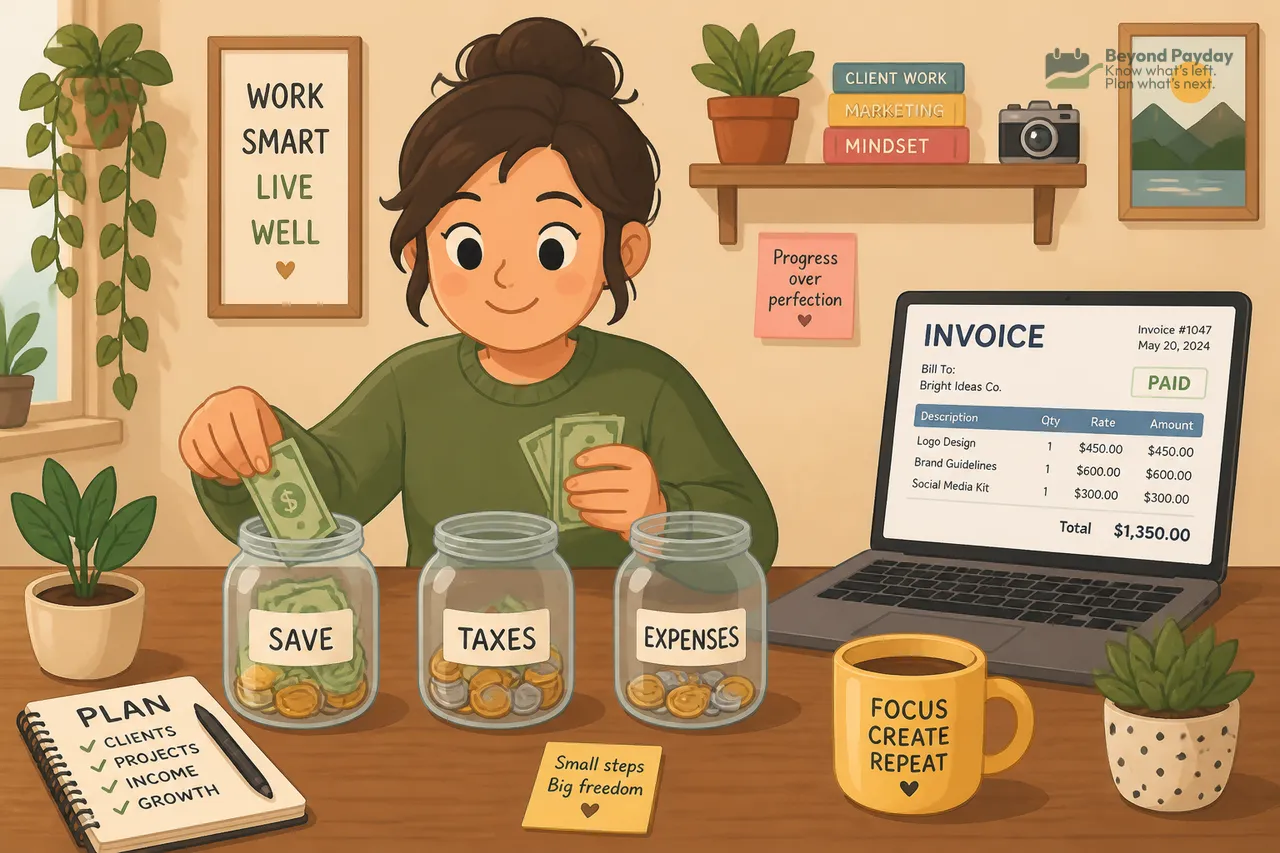
The habit that shows up again and again with people who handle 1099 income well: move a fixed percentage of every payment into a separate account the moment it lands, before it can get spent.
- Automate it — a transfer of your chosen percentage each time a payment arrives.
- Or batch it — review income monthly and move one lump sum.
- Either way, the tax money never gets treated as spendable.
Estimated payments: when and how much
The U.S. tax system is pay-as-you-go. For income without withholding, that happens through estimated tax payments.
- Who owes them: individuals who expect to owe $1,000 or more when they file, generally, per the IRS.
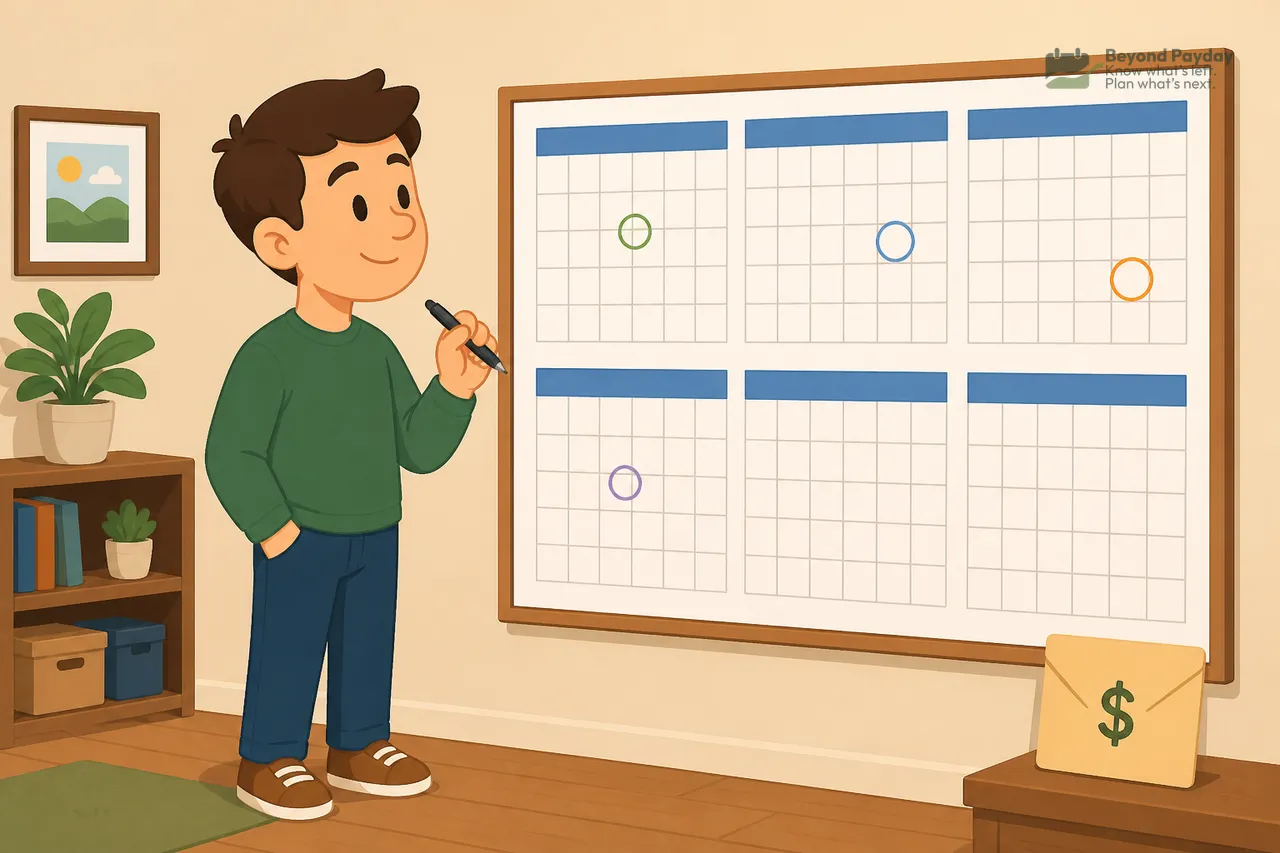
- 2026 due dates: April 15, June 15, and September 15, 2026, and January 15, 2027. The payments aren't equal "quarters" — the second covers only two months of income.
- Falling short during the year is what triggers the underpayment penalty, even if you pay everything by the April filing deadline.
Safe harbor, in plain numbers
Safe harbor rules let you avoid the penalty without knowing your final bill in advance. Generally, you're covered if withholding plus estimated payments reach the smaller of:
- 90% of this year's tax, or
- 100% of last year's total tax — 110% if last year's adjusted gross income was over $150,000 ($75,000 married filing separately), per the IRS.
The prior-year option is popular with new side hustles because the target is a number already printed on last year's return. You may still owe a balance in April — safe harbor protects against the penalty, not the tax.
Using a day job's withholding to cover side income
With a W-2 job and a side hustle, you may not need separate estimated payments at all.
- Extra withholding counts as paid evenly across the year, no matter which paycheck it came out of, per the IRS instructions for Form 2210. So bumping withholding in the fall can still cover side income earned in spring.
- The mechanism is Form W-4, which has a line for extra withholding per paycheck. It runs automatically after that.
- It only works if you actually adjust it. Leaving the W-4 unchanged doesn't account for the extra income.
Common mistakes people make
Watch out
The biggest and most common mistake is treating a full payment as spendable the day it arrives, then not having the tax portion when it's due.
- Spending the whole deposit — without a separate account or automatic transfer, the tax share is easy to spend by accident.
- Forgetting state tax — many people budget for federal and self-employment tax, then get surprised by the state bill.
- Forgetting self-employment tax — budgeting only for your income-tax bracket misses the ~14% that comes first.
- Mixing personal and business spending — one account and one card for both makes real business expenses hard to find later, which can mean overpaying.
- Estimating off gross instead of net — a percentage of every dollar received, instead of profit, builds a much bigger buffer than needed. Not a disaster, just inefficient.
- Assuming the day job's withholding covers it — it only does if you raised it.
A worked example (2026 rules)
Illustrative numbers, simplified to show how the pieces stack.
Assumptions: single filer, $60,000 W-2 salary, standard deduction, no state income tax, 2026 federal rules.
- Side-hustle gross income: $20,000
- Deductible business expenses: $4,000
- Net profit: $20,000 − $4,000 = $16,000
| Piece | Amount |
|---|---|
| Self-employment tax ($16,000 × 92.35% × 15.3%) | $2,261 |
| Added federal income tax (after the $1,130 half-SE-tax and $2,974 QBI deductions) | $1,967 |
| Total added federal tax | $4,228 |
| As a share of net profit | about 26% |
Why the income tax piece is lumpy: the salary already fills the 12% bracket up to $43,900 of taxable income. The first $6,500 of added taxable income lands at 12%, and the rest at 22%.
- Add a 5% state income tax and the set-aside climbs by roughly $800, to about 31%.
- Paid as estimated tax: about $1,057 on each of the four due dates.
- Or through the day job: about $163 of extra withholding per paycheck on a biweekly (26-check) schedule.
Limitations: this skips credits, itemized deductions, other income, and state-specific rules, all of which change the real number.
FAQ
Do I owe self-employment tax on a small side hustle if I only made a little money?
Self-employment tax generally applies once net earnings from self-employment reach $400 for the year, per IRS Topic 554. Income tax can still apply to smaller amounts.
Can I cover side-hustle taxes through my day job's paycheck withholding instead of sending in quarterly payments?
Often, yes. The IRS treats withholding as paid evenly across the year no matter when it came out, so raising withholding on Form W-4 can take the place of estimated payments (IRS Form 2210 instructions).
What happens if I don't set aside enough and can't pay what I owe by the deadline?
Underpaying during the year can add an underpayment penalty on top of the tax, unless a safe harbor applies. The IRS also offers payment plans for balances you can't pay in full at filing.
Do business expenses actually lower how much tax I owe on side income?
Yes. Ordinary and necessary business expenses reduce net profit, which lowers both income tax and self-employment tax, since both are figured on profit rather than gross receipts.
Is self-employment tax the same thing as income tax?
No. Self-employment tax (15.3% on 92.35% of net profit) funds Social Security and Medicare; income tax is a separate calculation based on taxable income and your bracket.
Do I owe tax on side income if I never got a 1099?
Yes. Self-employment income is taxable whether or not a form is issued — and for 2026, clients generally only have to send a 1099-NEC once payments reach $2,000.
Related reading

Beyond Payday is a planning tool, not a financial advisor. This article is educational — projections and examples are estimates, not financial, tax, or investment advice.