

Your budget can say you're fine for the month and your bank account can still overdraft on the 14th. That's not a contradiction — it's two different questions getting mixed up. A budget answers "can I afford this, overall?" Cash flow answers "will the money actually be there on that specific day?" You need both answers, not just one.
- A budget totals income and expenses over a period (usually a month) to check if they roughly match.
- Cash flow tracks the day-to-day order money arrives and leaves, which is what your actual bank balance depends on.
- A budget can balance on paper and still bounce a payment if a bill's due date falls before the paycheck meant to cover it.
- Annual and quarterly bills, and variable income, make this mismatch more likely because monthly averages hide lumpy real-world timing.
- A buffer — a small cushion left in checking — absorbs normal timing gaps. It is not the same thing as an emergency fund.
Two different questions, two different tools
A monthly budget adds up your income and your expenses and checks the totals against each other. It's the right tool for questions like: is rent too much of my income? Can I afford a new car payment? Is there room to save more? The CFPB's spending rule worksheet is a good example of this kind of monthly view — it splits spending into needs, wants, and savings as shares of take-home pay.
But a monthly total doesn't know or care what order things happen in. It treats a paycheck that lands on the 30th the same as one that lands on the 1st, as long as both fall in the same month. Your bank account doesn't work that way. It only knows what's in it right now, today, before the next deposit clears.
That's the gap cash flow fills. The CFPB's Your Money, Your Goals toolkit describes this kind of tracking as lining up income and spending by date, and prioritizing which bills get paid when money is tight — a day-by-day view rather than a monthly total.
Why a balanced budget can still bounce a payment
A budget can be completely accurate and still miss the thing that actually causes an overdraft. A few common causes:
- Payday-to-due-date gaps. If a bill is due on the 3rd but your paycheck for that pay period doesn't land until the 5th, the money for that bill technically exists "this month" — just two days too late.
- Annual and quarterly bills. Car insurance, some subscriptions, property taxes, and annual memberships often show up as one lump charge instead of a smooth monthly cost. A budget that averages a $720 six-month premium into "$120/month" is accurate on average, but the real charge still hits all at once on one specific day.
- Variable or irregular income. Hourly shifts, commissions, freelance invoices, and gig payouts can arrive on different days or in different amounts each period. A budget built on an average monthly total can still leave a real gap in a specific week when the money hasn't shown up yet.
- Three-paycheck months. Biweekly pay means 26 checks a year, so two months (occasionally three) get a third check. A budget built on the smoothed monthly average quietly assumes money that doesn't arrive in the other ten months — the year balances, a given month may not.
- Front-loaded bills. Rent, mortgage, and some loan payments often fall early in the month, while paychecks for hourly or biweekly workers can land in the middle or at the end. If the big bill hits before the paycheck that's "supposed" to cover it, the sequence is what fails, not the total.
Watch out
A balanced monthly budget tells you the totals work. It does not tell you whether a specific bill's due date falls before or after the paycheck you're counting on to pay it. Those are separate checks.
How to map bill due dates against paydays
The practical fix is a simple side-by-side list, not a new budgeting philosophy. A few ways people do this:
- List every recurring bill with its actual due date — not "around the 1st," the real date, including annual or quarterly ones and the date they actually charge.
- List every expected pay date for the next one to two months, especially if pay is biweekly, semi-monthly, or variable.
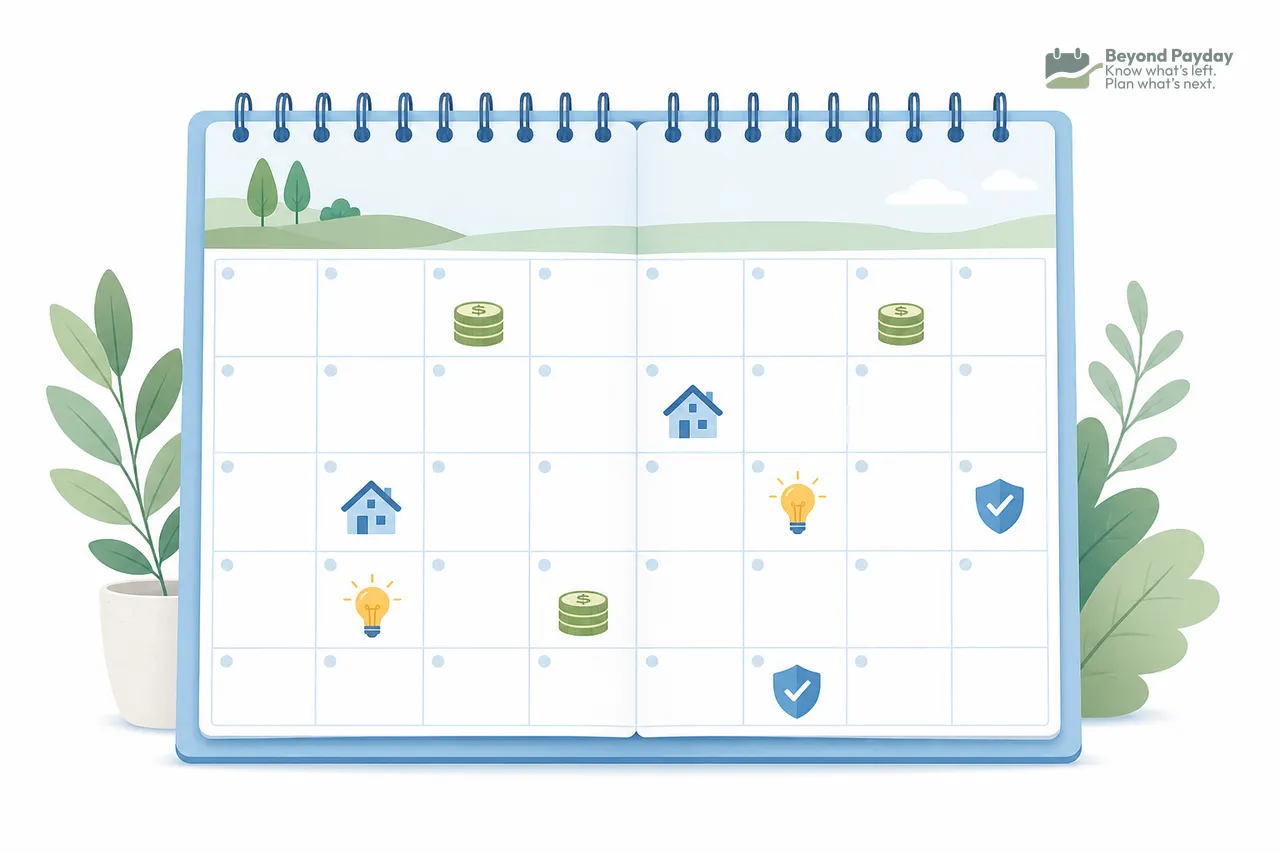
- Line the two lists up on a calendar and look for any bill due before a paycheck that was meant to cover it.
- Flag lump-sum bills separately (insurance, annual subscriptions, taxes) since these are the ones most likely to blindside a monthly-average budget.
- Repeat for at least two or three months, since biweekly pay dates shift relative to the calendar and a mismatch that isn't there in March can appear in April.
- Find the low point. Walk the balance forward day by day. The number that matters isn't the month-end surplus — it's the lowest balance the account hits, and the date it hits it. If that number dips below zero, the budget can balance and still bounce.
The buffer, and why it isn't an emergency fund
A buffer is a small amount of money kept sitting in a checking account, above whatever the budget says the balance "should" be. Its whole job is to absorb ordinary timing gaps — a bill landing a few days before a paycheck, a slightly late invoice, a bank holiday that pushes a direct deposit back a day.
An emergency fund is a different tool for a different risk. It's a separate reserve meant to cover a real loss of income or a large unplanned cost, like a job loss or a major repair, over weeks or months. Related reading on sizing that reserve is covered in a separate piece on emergency funds.
| Buffer | Emergency fund | |
|---|---|---|
| Purpose | Smooths normal timing gaps between paydays and bills | Covers income loss or a major unplanned expense |
| Where it lives | Usually left in the checking account | Usually kept separate, sometimes in a savings account |
| Size | Small — enough to cover the gap between a bill and the paycheck meant for it | Larger — sized to cover weeks or months of expenses |
| How often it's used | Regularly, even in a "normal" month | Rarely, ideally only for genuine emergencies |
Mixing the two is a common mistake. Treating the emergency fund as the buffer means dipping into it every month for routine timing gaps, so it never actually grows to cover a real emergency. Treating the buffer as an emergency fund means assuming a few days' cushion can absorb a job loss, which it usually can't.

Getting out of the paycheck-to-paycheck timing trap
The "timing trap" is when income and bills technically balance for the month but the account still runs to zero or negative on specific days, over and over. A few approaches people commonly use to break the cycle:
- Build a small buffer gradually, even a modest one, so a bill due a few days before payday doesn't immediately cause a shortfall.
- Ask billers to move due dates closer to payday — many utility, loan, and card issuers allow this, which directly shrinks the gap causing the mismatch. Card due dates are a good anchor: a federal law called the CARD Act requires a card's due date to fall on the same day every month.
- Pay ahead when a heavier paycheck allows it, effectively pre-funding a bill that's due before the next paycheck arrives.
- Set aside a portion of income each pay period for lump-sum bills (insurance, annual fees) instead of budgeting them as a flat monthly average, so the cash is actually there when the real charge hits — an approach sometimes called a sinking fund.
- For variable income, some people budget off their lowest realistic pay period and treat anything above that as a buffer top-up, rather than budgeting off an average that may not exist in any single paycheck.
When to look at the budget, and when to look at cash flow
Both views matter, but for different decisions:
- Look at the budget when deciding whether to take on a new bill, whether spending in a category is too high, or whether there's room to save more overall.
- Look at cash flow when deciding whether a specific bill can be paid on its due date, when timing a large purchase, or when trying to figure out why an account keeps running low despite a budget that adds up.
- Look at both when something isn't adding up — a budget that balances but an account that doesn't usually means the totals are fine and the timing isn't.
Worked example: a month that balances but still fails
Illustrative numbers.
The budget, for the month:
| Category | Amount |
|---|---|
| Take-home pay (two paychecks of $1,800) | $3,600 |
| Rent | $1,200 |
| Car payment | $300 |
| Utilities | $180 |
| Groceries | $450 |
| Subscriptions | $40 |
| Six-month car insurance premium (due this month) | $720 |
| Everything else | $310 |
| Total expenses | $3,200 |
| Budget surplus | +$400 |
On paper, this month is fine — income exceeds expenses by $400.
The cash-flow timeline is where it breaks:
- Rent is due on the 1st.
- The car insurance premium is due on the 5th.
- The first paycheck of the month, this particular pay cycle, doesn't land until the 8th.
- Starting cash left over from the prior month is only $150.
By the 5th, $1,920 in bills ($1,200 rent + $720 insurance) is due, but only $150 is in the account — the paycheck meant to cover them doesn't arrive for three more days. Depending on the bank and the biller, that shows up as an overdraft fee, a declined or returned payment, or a late charge. The month's totals were never the problem; the order things happened in was.
Tip
This is exactly the kind of gap a calendar-based comparison of due dates and pay dates catches, and a monthly budget total cannot.
If mapping bills against paydays sounds like a chore you'd rather not do by hand every month, that's exactly the kind of thing a budgeting tool can lay out automatically.
FAQ
Is cash flow the same thing as a budget?
No. A budget totals income and expenses for a period, usually a month, to show whether they roughly match. Cash flow tracks the day-by-day timing of money moving in and out, which is what actually determines your account balance on any given date.
Is a cash buffer the same as an emergency fund?
No. A buffer is money kept in a checking account to smooth out normal timing gaps between paydays and bills. An emergency fund is a separate, larger reserve meant for unplanned events like job loss or a major repair.
Why does my budget say I have money left over, but I still overdraft?
A monthly budget can balance in total while the order that money arrives and leaves doesn't line up — for example, a big bill due before your next paycheck lands, even though the paycheck comes later in the same month.
How do irregular or variable paychecks make this worse?
When pay amounts or dates shift, as with hourly, commission, freelance, or gig income, it's harder to know in advance which bills a given paycheck needs to cover, which raises the odds of a timing mismatch.
What's a simple first step to stop bouncing payments even though my budget looks fine?
Many people start by listing every bill's due date next to their actual pay dates for a couple of months, which usually reveals the specific days when money is tight, even if the month as a whole balances.
Related reading
Where does your money go? How to track your spending
You can't fix a budget you can't see. Here's how to track spending manually or automatically, sort it into categories that mean something, and actually use the review.

How big should your emergency fund be?
The standard rule is 3–6 months of essential expenses, but the right number depends on how stable your income and job actually are.

How to budget on an irregular or variable income
Freelancers, commission earners, and gig workers can still budget with confidence. The key is budgeting off your lowest month, not your average.
Beyond Payday is a planning tool, not a financial advisor. This article is educational — projections and examples are estimates, not financial, tax, or investment advice.