
Renting isn't "throwing money away," and buying isn't automatically the smarter move. Both put a roof over your head; the real question is which one costs less in total, over the time you actually expect to be in that home — and total cost includes a long list of expenses that never show up in a simple mortgage-vs-rent comparison.
- Ownership costs a lot more than the mortgage payment. Property tax, insurance, maintenance, possible mortgage insurance, and closing costs on both ends all add up.
- Buying usually needs several years to pay off because the costs of buying and selling are large. Sell too soon, and renting often would have cost less.
- Selling alone typically costs about 6–8% of the price, mostly agent commissions, per 2025–2026 data from Redfin and Clever Real Estate.
- The break-even point moves with how fast local home prices and rents change, the loan terms, and the size of the down payment.
- Non-financial factors matter just as much. Being able to move easily and control your own space don't show up in any spreadsheet.
- Local market conditions dominate the math. The same household can come out ahead buying in one metro and ahead renting in another.
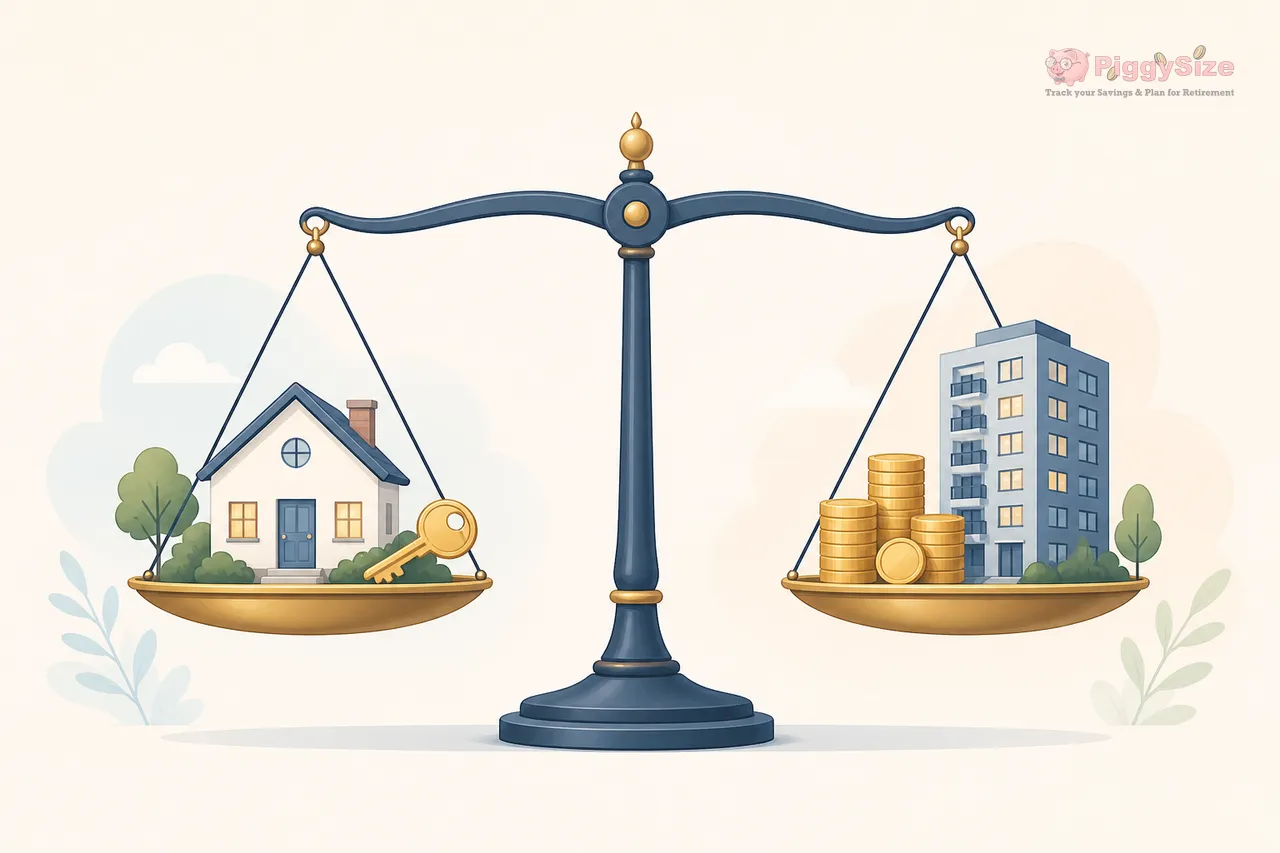
Why "rent is throwing money away" misses the point
A mortgage payment isn't pure savings either. Most of it goes toward:
- Interest, which, like rent, is a cost of using something (here, the bank's money) and builds nothing
- Property tax and insurance, which never come back to you
- Only a slice of principal, especially in the early years of the loan. That's the part that actually builds equity
Renters build no home equity, that's true. But owners also sink money into costs with no payback: maintenance, taxes, insurance, closing fees. Comparing the two fairly means adding up every cost on each side, not just comparing rent to a mortgage payment.
The real costs of owning a home
A mortgage calculator only shows one line. Total ownership cost has several more, and they're often bigger than people expect, according to guidance from the CFPB:
| Cost | What it is | When it applies |
|---|---|---|
| Principal & interest | The loan payment itself | Every month, for the life of the loan |
| Property tax | Set by local government, based on assessed home value | Every month or year, for as long as you own |
| Homeowners insurance | Protects against fire, storm damage, liability, etc. | Every year, required by most lenders |
| Private mortgage insurance (PMI) | Extra monthly charge lenders typically require on a conventional loan with less than 20% down | Until you can cancel it — see the note below |
| Maintenance & repairs | Roof, heating and cooling, appliances, plumbing, landscaping | Ongoing and unpredictable — some years are cheap, some are not |
| HOA (homeowners association) or condo fees | Dues for shared amenities and upkeep | If the property is part of an association |
| Closing costs (purchase) | Lender fees, appraisal, title search and insurance, inspection, government recording fees | Once, when buying |
| Selling costs | Agent commissions, title and escrow fees, transfer taxes, repairs requested by buyers | Once, when selling |
Note
PMI doesn't last forever on conventional loans. Under the federal Homeowners Protection Act, borrowers can ask to cancel PMI once the balance is scheduled to hit 80% of the home's original value, and it must end automatically at 78% if payments are current (CFPB). Mortgage insurance on FHA loans follows different rules and, on many of them, lasts much longer.
Watch out
Maintenance costs are lumpy, not smooth. A furnace or roof replacement can cost thousands in a single year. That's very different from a flat monthly rent.
What selling costs after the 2024 commission rule changes
Selling a home typically costs about 6–8% of the sale price, all in. Most of that is agent commissions. The rest is the seller's share of closing costs.
- Commissions still run roughly 5–6% combined. Clever Real Estate's 2026 survey of 533 agents put the average total at 5.70%: 2.88% for the listing agent and 2.82% for the buyer's agent, up from 5.44% in 2025. Redfin's data on closed sales found buyer's agents averaged 2.42% in the third quarter of 2025, a little lower than what agents report charging.
- The NAR settlement changed the process more than the price. Since August 2024, a listing can't advertise an offer of pay to the buyer's agent on the MLS, and buyers sign a written agreement with their own agent before touring. Commissions were always negotiable, and they still vary by market and price.
- Other seller costs add more. These include title and escrow fees, the seller's share of property tax for the year, and any transfer tax. Transfer taxes are zero in some states and several percent in a few high-tax states and cities.
- Buyer requests can add to it. Repairs or credits a buyer negotiates after inspection come out of the seller's proceeds too.
The down payment has a cost too
Money put toward a down payment stops being available for anything else. That's the opportunity cost of a down payment, and it's real even though it never appears on a mortgage statement. What that money might have earned elsewhere depends entirely on where it would have gone and how markets performed, which is inherently uncertain.
The tax break is smaller than most people assume
"You get to write off the interest" is one of the most repeated reasons to buy. For most owners, it's worth little or nothing.
- Mortgage interest and property tax only reduce taxes if you itemize. For tax year 2026 the standard deduction is $16,100 for single filers and $32,200 for married couples filing jointly (IRS). Itemizing only saves tax on the amount above that.
- About 1 in 10 federal returns itemized in tax year 2022, down from roughly 31% in 2017, according to IRS data summarized by the Tax Policy Center.
- The 2025 tax law raised the cap on the state and local tax deduction, so somewhat more homeowners in high-tax areas may itemize again. The benefit is still only the tax saved on the amount above the standard deduction, not the full interest paid.
- The bigger tax perk is often at sale. Owners who lived in the home at least two of the last five years can generally leave up to $250,000 of profit on the sale out of taxable income ($500,000 for most married couples filing jointly), per IRS Publication 523.
Tax rules change and depend on the whole return, so the actual effect for any household is a question for a tax professional.
What renting costs that people forget
Renting has its own less-obvious costs, just smaller ones:
- Security deposits and application/broker fees, paid upfront and sometimes not fully refunded
- Rent increases at renewal, which aren't capped nationally and vary a lot by local market and lease terms
- Renter's insurance, a smaller but real recurring cost
- No control over major decisions — a landlord chooses when to renovate, raise rent, or sell the property
Renters also avoid surprise repair bills and the risk that comes with borrowing a large sum. That's a form of financial protection, even if it's not counted in dollars.
Watch out
Renting only wins the long-run math if the difference gets saved. Most rent-vs-buy comparisons assume the renter invests the down payment and any monthly savings. If that money gets spent instead, the renter's advantage mostly disappears — which is the real kernel of truth behind "forced savings."
The break-even horizon: why time matters more than the payment itself
Buying tends to come out ahead only after you stay long enough for ownership's advantages to outweigh the large costs of buying and selling. This is often called the break-even horizon: the point where the total cost of owning so far drops below the total cost of renting so far.
Before that point, closing costs on the purchase (and on the sale, if you sell) tend to outweigh the equity built up. That's why moving out a year or two after buying is one of the more common ways to lose money on a home purchase, regardless of what happens to prices. For context, the National Association of Realtors' 2025 Profile of Home Buyers and Sellers found the typical seller had owned their home for 11 years — a record high.

What shortens the break-even horizon
- Rents rising faster than home prices in the local market, making renting comparatively more expensive over time
- A larger down payment, which lowers interest cost and can avoid mortgage insurance
- Lower closing costs or commissions, which are sometimes negotiable or vary by loan type
- Staying long enough to avoid a second round of transaction costs from selling and buying again
What lengthens it
- High closing costs or a small down payment that adds mortgage insurance
- Home prices flat or falling while rents stay level or drop
- Heavy or unexpected maintenance costs, especially in older homes
- Uncertainty about how long you'll stay. Job changes, family needs, or health can force an early, costly sale.
There is no single break-even number that applies everywhere. It depends on local prices, local rents, financing terms, and how a specific home performs — all things that vary by market and by year.
The parts a spreadsheet can't capture
Even a perfect cost comparison leaves out real trade-offs that matter to different people differently:
- Mobility. Renting makes it easier to move for a job, a relationship, or a change in circumstances without a sale process attached.
- Control. Owners can renovate, keep pets, or make a space their own without asking permission — renters generally can't.
- Being tied to a location. A home purchase ties a large share of net worth to one property in one market. If that local market or job market weakens, moving becomes harder and more expensive.
- Stability. Owners with a fixed-rate loan have a payment that doesn't rise with market rents (though taxes, insurance, and maintenance can still increase).
- Forced savings. A mortgage payment builds equity automatically over time, which works like a savings habit for people who might not otherwise save consistently.
None of these are wrong to weigh — they're just not dollar amounts, and any comparison that ignores them is incomplete in a different way than one that ignores maintenance costs.
Key point
Neither renting nor buying is universally better. Local home prices relative to local rents, how long someone plans to stay, and personal priorities around flexibility and control all shape which one comes out ahead in a specific case.
An example with real numbers
Illustrative numbers, to show how the pieces fit together.
Assumptions:
- Home price: $350,000
- Down payment: 10% ($35,000), which means paying PMI until the loan falls to about 78–80% of the original price
- Estimated annual costs beyond principal and interest: property tax, insurance, and maintenance combined, assumed at roughly 2.5% of home price per year ($8,750/year, or about $730/month)
- Closing costs on purchase: assumed at 3% of price ($10,500)
- Selling costs if sold: 7% of the sale price. That's about 5.5% in agent commissions (between Redfin's 2025 closed-sale data and Clever Real Estate's 2026 agent survey) plus about 1.5% in other seller closing costs
- Comparable rent for a similar home: assumed at $2,000/month to start
- Loan: $315,000, 30-year fixed at an assumed 6.5% — about $1,991/month in principal and interest
Year one, side by side (PMI left out, which makes owning look slightly better than it is):
| Buying | Renting | |
|---|---|---|
| Mortgage interest | ≈ $20,370 | — |
| Property tax, insurance, maintenance | ≈ $8,750 | — |
| Rent | — | $24,000 |
| Unrecoverable cost | ≈ $29,120 | $24,000 |
| Purchase closing costs (one-time) | $10,500 | — |
| Principal paid down (becomes equity) | ≈ $3,520 | — |
Of roughly $23,900 in loan payments that year, only about $3,520 builds equity. The rest is interest. That's amortization at work: on a standard 30-year mortgage, early payments are mostly interest.
What this shows:
- Year one costs the buyer about $5,100 more than renting, plus $10,500 in purchase closing costs. That's before counting what the $45,500 of cash at closing might have earned elsewhere.
- Selling after two years at the same price would hurt. The owner's equity would be about $42,300: the $35,000 down payment plus about $7,300 of principal paid. Selling costs of 7% ($24,500) would take about 58% of it.
- Buying and selling together cost about $35,000 in this example ($10,500 + $24,500). The owner only comes out ahead once principal paid down and any rise in the home's value outweigh that. How many years that takes depends on how local rents and home prices move.
Changing any single input — a smaller down payment, higher local property taxes, rents that rise quickly, or a home that needs a new roof — moves the break-even point earlier or later. That sensitivity is the whole point: there's no universal answer, only a personal one built from local numbers.
If comparing scenarios like this feels like a lot of moving parts to track by hand, a savings goal tool can help model how a down payment fund grows over time so the comparison uses real numbers instead of guesses.
FAQ
Is it always cheaper to buy than to rent long-term?
No. It depends on how long you stay, local home prices relative to rents, and how much of the purchase you finance — in some markets renting stays cheaper even over decades.
How long do you need to stay in a home for buying to make sense?
There's no fixed number — it depends on closing costs, how fast local home values and rents move, and financing terms. Many analyses treat several years as a rough minimum to absorb transaction costs; for context, NAR's 2025 data shows the typical seller had owned for 11 years.
Does paying rent really mean the money is wasted?
Rent pays for housing you're using, just like a mortgage payment covers interest, and ownership costs like taxes and maintenance don't build equity either — so "wasted" oversimplifies a comparison that depends on total costs on both sides.
What is private mortgage insurance and when do I pay it?
Private mortgage insurance (PMI) is an extra monthly cost some lenders require when a down payment is smaller than a set threshold, and it protects the lender — not the borrower — against default, per the CFPB.
Do closing costs apply when renting too?
Renting usually involves smaller upfront costs like a security deposit and possibly a broker fee. Buying and selling both carry larger transaction costs, such as loan fees, title costs, and agent commissions.
How much does it cost to sell a house after the NAR settlement?
Often about 6–8% of the sale price in total. Agent commissions still average roughly 5–6% combined (Clever Real Estate's 2026 agent survey found 5.70%; Redfin found buyer's agents averaged 2.42% on closed sales in late 2025). Title fees and transfer taxes add more, and vary a lot by state.
Related reading

How to save for a house down payment
A down payment can be far smaller than the "20% down" rule implies — here is how much you actually need, the PMI trade-off, and the timeline math.

Should you pay off your mortgage early?
It depends on your mortgage rate, how much liquidity you'd give up, and how much you value the certainty of no payment over the flexibility of investing instead. Here's how to weigh it.

High-yield savings vs investing: where should your money go?
The choice usually comes down to time horizon and risk, not which one is "better" — here is how to think about splitting money between the two.
Beyond Payday is a planning tool, not a financial advisor. This article is educational — projections and examples are estimates, not financial, tax, or investment advice.