


Cutting monthly bills isn't one trick — it's a method applied to a list, followed by category-specific moves. The method matters more than any single tip: find every recurring charge, decide which ones to stop paying for entirely and which to keep but pay less for, and work the biggest ones first.
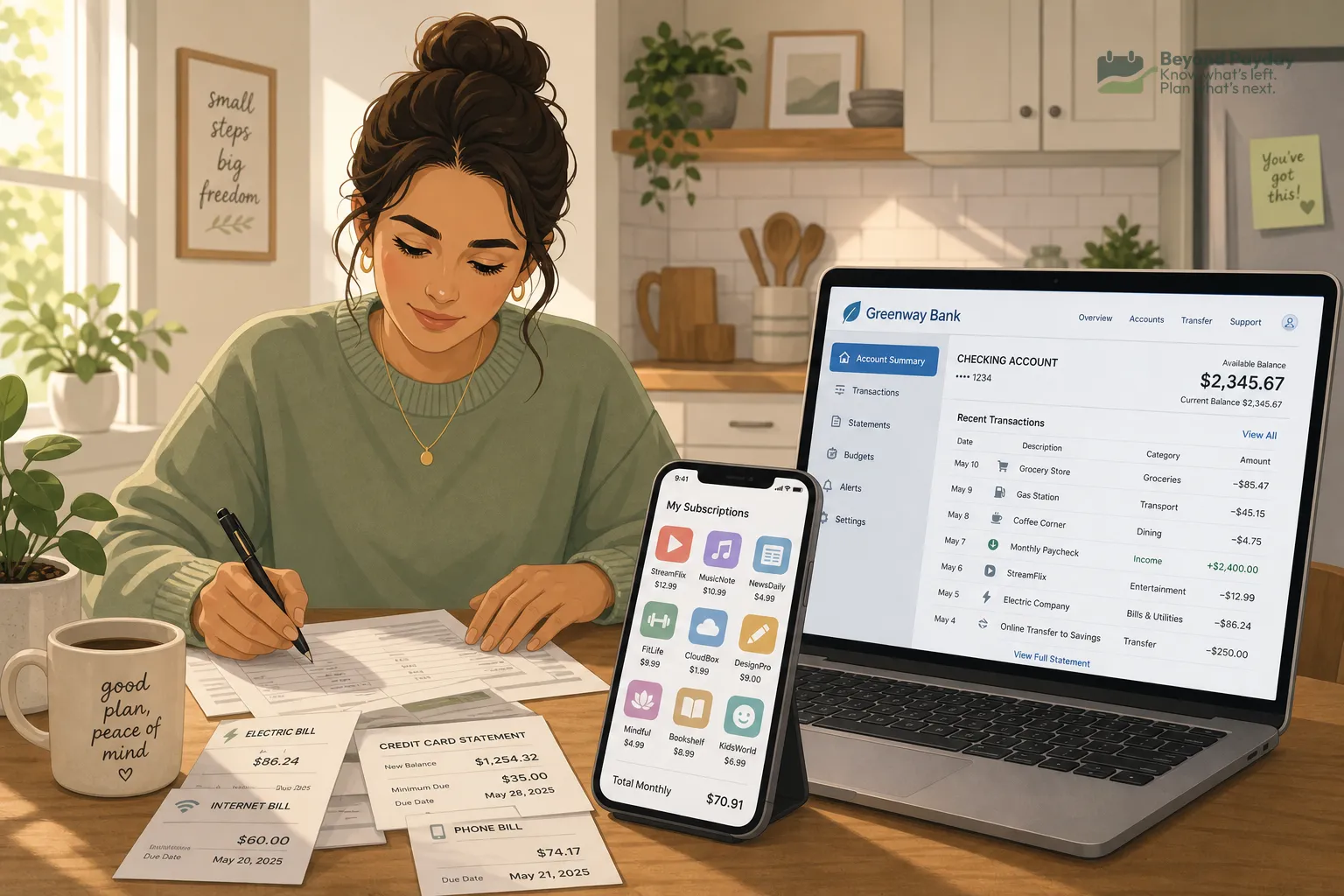
- List every recurring charge in one place using 12 months of bank and card statements plus the phone's app-store subscription list, since that's where hidden charges hide.
- Sort by annual cost, not monthly — a $22/month line is a $264/year decision, and that reframes what's worth a phone call.
- Split the list into two piles: things to cancel outright (wants) and things to keep but shop down (needs) — they take different tactics.
- Two moves work almost everywhere: asking for the retention or loyalty team by name, and knowing exactly when a promotional rate ends.
- Some bills genuinely can't be cut, and categories like insurance and prescriptions have real safety rules that come before any savings goal.
The method: find the list before you touch a single bill
Most people can name their five biggest bills. Almost nobody can name all thirty. The Consumer Financial Protection Bureau’s Your Money, Your Goals toolkit frames the first step of any spending plan as simply tracking what's coming in and going out — before deciding what to change.
Pull two sources, not one:
- 12 months of bank and card statements. A full year catches annual and seasonal charges — an annual domain renewal, a yearly membership fee, a holiday-season subscription — that a single month's statement misses entirely.
- The phone's built-in subscription list, found in the app store or account settings. This matters because a bank statement often shows only the app store's own name (a generic billing descriptor), not the actual app or service being charged for. The subscription screen shows the real name and renewal date.
Then do two separate sorts.
Sort 1: annual cost, not monthly
A $9.99/month charge looks trivial. Annualized, it's about $120/year. A $22/month line is $264/year. Ranking every charge by its yearly total — instead of its monthly sticker price — usually reorders the whole list and reveals which lines are actually worth a call.
Sort 2: keep vs. cut
Every recurring charge falls into one of two buckets, and mixing them up wastes effort:
- Wants you could stop paying for entirely — a streaming tier nobody's watched in months, a gym membership that's gone unused, a subscription box. The tactic here is simple: cancel it.
- Needs you're keeping but might pay less for — the phone plan, the internet bill, the car insurance, the electricity bill. The tactic here is different: negotiate, re-shop, or right-size the same service, not eliminate it.
Trying to "cut" a need the way you'd cancel a want (or negotiate a want the way you'd negotiate a need) is a common source of frustration. One common framework for separating needs, wants, and savings at a household level is the Consumer Financial Protection Bureau’s “my spending rule to live by” worksheet, which splits a budget roughly into needs, wants, and savings/debt payments as a starting point to adapt, not a fixed rule.
Work the biggest few first
Once the list is sorted by annual cost, the largest three to five lines usually represent most of the total opportunity. A single call that changes a $70/month phone plan does more than an hour spent chasing a $6 app subscription. This is also why recurring costs carry more leverage than one-off purchases: one phone call or account change affects twelve or more future payments at once, where a one-time purchase decision only affects that one purchase.
The two moves that work almost everywhere
Across phone, internet, insurance, gyms, and even some subscriptions, two tactics show up again and again.
1. Ask for the retention or loyalty team
Front-line customer service reps often can't offer the best available rate — a retention team or loyalty department usually can. Asking for that department by name, or saying the account is being considered for cancellation, is often the step that unlocks a different conversation.
2. Know the promo end date before it hits
Many services start with a promotional or intro rate that quietly reverts to a standard price after 6, 12, or 24 months. Calendar reminders set at signup — not a surprised reaction to a higher bill months later — are what let someone renegotiate or switch before the higher rate is ever paid.
A short script that works for most categories
A plain, low-drama script tends to work better than an apologetic or aggressive one:
"Hi, I've been a customer for [length of time]. I'm reviewing my bills and comparing options. Can you tell me what promotions or loyalty offers are available on my account right now? If not, could I speak with your retention team?"
When the answer is no
Sometimes there's genuinely nothing available that day. Three follow-up questions keep the door open without escalating the call:
- "What's the cheapest plan you offer that still covers what I need?"
- "What would need to change for me to qualify for a better rate?" (bundling, autopay, a different plan tier, a loyalty tenure threshold)
- Set a reminder to call again at the next renewal or promo expiration date — offers change, and being told no in January doesn't mean the answer is the same in July.
Phone, internet, and TV
- Right-size data and speed to actual usage — many people pay for far more mobile data or internet speed than they use in a typical month.
- Stop renting equipment. Modems, routers, and cable boxes are often available to buy outright or already owned by many households, ending a small recurring rental fee.
- Drop unused add-ons: device insurance, international calling passes, premium channel packages that duplicate a streaming subscription.
- Call before a promo expires, not after the higher bill arrives.
- Price the bundle against separate services. Bundled phone/internet/TV isn't automatically cheaper than buying each piece separately — it's worth comparing both ways.
- Check for overlap between a cable package and streaming subscriptions already being paid for elsewhere.
- An antenna can pick up local broadcast channels for free in many areas, reducing reliance on a cable tier bought mainly for local news and network shows.
- Ask about Lifeline or low-income internet programs, which offer discounted phone or internet service to income-eligible households; eligibility and availability vary by state and provider.
Utilities
- Check the bill for meter or rate errors before assuming usage is the only factor — misreads and rate-class mistakes happen.
- Ask what rate plans exist, including time-of-use rates, which can lower a bill for households that can shift some usage to off-peak hours.
- Ask about a free energy audit and available rebates, often offered by utility providers for insulation, smart thermostats, or appliance upgrades.
- Ask about a water-leak adjustment credit if a bill spikes unexpectedly — a running toilet or underground leak is the classic hidden cause, and many water utilities offer a one-time bill credit once the leak is fixed and verified.
- Consider a smaller trash cart or a seasonal service hold, where offered, if the current size or schedule isn't needed.
- Shop heating fuel dealers and ask about pre-buy or budget plans in areas where oil or propane isn't a regulated utility.
- Ask about LIHEAP or a Weatherization Assistance Program, federally funded programs (administered at the state level, so rules vary) that help eligible households with energy costs or home efficiency upgrades.
- Budget billing smooths the bill, it doesn't lower the total. It's worth saying plainly: a budget billing plan averages a year of usage into equal monthly payments, which helps with predictability, but it doesn't reduce what's actually owed over the year.
Insurance
- Re-shop at renewal against the same coverage, not a cheaper one — compare identical deductibles, limits, and coverage types across quotes, or the comparison isn't meaningful.
- Ask for the full discount list every provider maintains — bundling, safe-driver, good-student, home security systems, and more, since not all are applied automatically.
- A higher deductible only makes sense with cash on hand to cover it — raising a deductible lowers the premium but raises the amount owed out of pocket if a claim happens.
- Check for duplicate coverage already provided elsewhere: some credit cards include rental car coverage or cell phone protection, and some auto policies include roadside assistance also sold separately.
- Re-rate after life changes — a move, a paid-off car loan, a new safety feature, or a change in commute distance can all shift pricing.
Watch out
Never cancel an existing life, disability, or health insurance policy before a replacement policy is actually in force and confirmed in writing. A gap between canceling old coverage and the new policy starting can leave a household or an individual completely uninsured during that window. The same caution applies to any coverage a lender, lease, or state requires — those aren't optional even if a cheaper alternative looks tempting.
Subscriptions and streaming
- Rotate instead of stacking. Subscribing to one streaming service for a month to watch what's wanted, then canceling and moving to the next, avoids paying for several services simultaneously.
- Try the ad-supported tier, now offered by many streaming services at a lower price than the ad-free version.
- Check what's already included elsewhere — some phone plans, shopping memberships, and credit cards bundle a streaming subscription at no extra charge.
- Compare the website price with the in-app price. App-store billing is often marked up compared with subscribing directly through a browser, since app stores commonly take a cut of in-app subscription revenue.
- Set a reminder before a free trial ends — this is the single most common way a subscription becomes an unwanted recurring charge.
- Look at family or duo plans if multiple people in a household are separately paying for the same service.
- The library is a genuinely free source of streaming video, audiobooks, ebooks, and even museum or attraction passes through many public library systems.
- Ask for a retention offer at the cancel screen — many services present a discounted alternative before completing a cancellation.
- Cancel inside the account directly (not just by deleting the app) and keep the email or screenshot confirmation.

Software and AI tools
- Clear out cloud storage instead of upsizing — deleting old backups, duplicate photos, and large unused files often avoids the need to buy the next storage tier.
- Check for storage or an AI tool already bundled into an office suite, phone plan, or shopping membership before paying for a standalone one.
- Drop to a single-app tier if a broader software bundle is being paid for but only one app is actually used.
- Remove unused seats on any plan billed per user or per license.
- Ask about student, teacher, or nonprofit pricing, commonly offered at a discount by many software providers with eligibility verification.
- Watch the renewal price, not the intro price, especially on security software and web hosting, where the second-year price is often noticeably higher than the first.
- Consider built-in operating system protection and a free credit freeze as an alternative to paying for stacked identity-monitoring or antivirus products that duplicate free tools.
Gym, fitness, and classes
- Check for an employer, insurer, or Medicare Advantage fitness benefit — many plans include a subsidized or free gym membership that goes unused simply because it's unknown.
- Ask to waive the signup and annual fees, which are often negotiable, especially near a slow enrollment period.
- Find the exact date the annual fee hits and set a reminder to cancel or renegotiate before it renews automatically.
- Freeze rather than cancel during a travel period, injury, or seasonal break — many gyms offer this at a lower or no cost, preserving any joining discounts.
- Consider the basic tier if premium classes or amenities aren't being used.
- City and county recreation centers often offer lower-cost memberships and classes than private studios.
- Use day passes for genuinely occasional attendance rather than a full membership.
- Read the cancellation rules before joining, not after — required notice periods and early-termination fees are easiest to plan around before signing.
Food
- Separate the grocery budget from the eating-out budget. Tracking them as two distinct categories makes it easier to see which one is actually driving overspending.
- Plan meals around what's already in the pantry and what's on sale, rather than building a shopping list from scratch each week.
- Compare store brands and unit prices, not shelf price alone — unit pricing (cost per ounce or item) is usually posted on the shelf tag.
- Use digital coupons in the store's app, which often stack with sale prices.
- Choose pickup over delivery where available, avoiding delivery and service fees.
- Reduce waste by tracking what actually gets thrown out — it's a direct signal of overbuying in a specific category.
- Ask about SNAP and WIC — federal nutrition assistance programs for eligible individuals and families, and for WIC, specifically pregnant, postpartum, and breastfeeding people and young children — administered at the state level with eligibility rules that vary.
Storage units, travel, and card fees
- Ask the storage facility manager to match the current new-customer online rate — existing customers are often on a higher rate than what's advertised to new sign-ups.
- Compare what's being stored against a full year of rent — sometimes replacing the stored items would cost less than another year of storage fees.
- Use flexible travel dates and fare alerts, and compare total trip cost including baggage, seat selection, and resort fees, not just the base fare or room rate.
- Know the 24-hour cancellation window many US airlines offer on newly booked flights, which allows a full refund within that period under applicable rules.
- Ask about waiving a credit card's annual fee, or ask about a product change to a no-annual-fee version of the same card. Before closing an older card entirely, it's worth checking the potential credit impact, since closing a long-held account can affect credit history length and utilization.
Medical and prescriptions
- Confirm in-network status before booking, since an out-of-network provider at an in-network facility is a common source of surprise bills.
- Ask for a good-faith estimate, a written estimate of expected costs that many providers are required to give for scheduled care when uninsured or self-pay.
- Wait for the explanation of benefits before paying a bill, since a bill sent directly by a provider may not yet reflect what insurance actually covers.
- Request an itemized bill, which lists each charge individually and can surface billing errors or duplicate charges.
- Ask about hospital financial assistance or charity care programs, which many nonprofit hospitals are required to offer to eligible patients.
- Ask about a cash or prompt-pay discount, sometimes offered for paying in full at the time of service.
- Ask about interest-free payment plans directly with the provider rather than using a medical credit card, which can carry deferred interest if not paid off in time.
- Compare a generic medication's cash price against the insurance copay — occasionally the cash price is lower than the copay, and pharmacists can usually check this on request.
- Ask about a 90-day supply for maintenance medications, which sometimes costs less per dose than three separate monthly fills.
Watch out
Cost concerns about a prescription are worth raising directly with a prescriber or pharmacist — they may be able to suggest a lower-cost alternative, a different pharmacy, or a manufacturer assistance program. Skipping doses, splitting pills not designed to be split, or stretching a prescription to make it last longer is not a recognized savings strategy and can affect how well a medication works.
Everyday and family costs
- Childcare: a Dependent Care FSA, the Child and Dependent Care Credit (a federal tax credit for care expenses that allows working parents to be employed or look for work), state child care assistance programs, and sibling discounts at care providers are all worth asking about; tax rules change and a qualified tax professional can speak to individual eligibility.
- Kids' activities: city recreation department programs are often priced well below private clubs for similar activities; many programs offer scholarships or reduced-fee spots; secondhand gear works for most equipment, but safety gear like helmets and car seats is generally recommended new.
- Pet care: comparing routine-care prices across local clinics, looking for low-cost vaccine clinics (often run by shelters or local health departments), and asking whether a prescription can be filled elsewhere with a written script from the vet are all common cost-lowering steps.
- Education: filing the FAFSA every year of enrollment, and never paying a company that charges a fee to search for scholarships, since legitimate scholarship searches are free.
- Tax prep: IRS Free File, VITA/TCE (VITA/TCE), and MilTax (a free tax service for eligible military members and some veterans) are all no-cost options worth checking eligibility for before paying a preparer.
- Rent: negotiating before renewal using an on-time payment record as leverage, and questioning add-on fees (amenity fees, "convenience" fees, mandatory package or trash fees) that sometimes aren't required by the lease.
- Property tax: checking for a homestead exemption or senior, veteran, or disability exemption; reviewing the assessor's public record for factual errors (wrong square footage, wrong number of bedrooms); and appealing an assessment before the local deadline if it appears inflated. Rules and deadlines vary by county and state.
- Home repairs and services: checking a home warranty or homeowners insurance policy before paying out of pocket, getting three written quotes for larger jobs, and getting a second opinion before agreeing to a full system replacement.
- Driving costs: using regular fuel unless the owner's manual specifically requires premium, keeping tires at the recommended pressure, following the manual's maintenance schedule instead of a shop's upsell recommendations, using pre-tax commuter benefit programs where offered by an employer, and charging an electric vehicle at home during off-peak hours where a time-of-use rate applies.
Discounts worth asking about
A short, direct question — "which discounts do I qualify for?" — often surfaces more than browsing a provider's website. Common categories tied to real, named programs:
- Military and veterans discounts, offered by many providers with proof of service.
- First responder discounts for police, fire, and EMS personnel.
- Teacher and educator discounts, often requiring a school email or ID.
- Nurse and healthcare worker discounts.
- Student discounts, often verified through a school email address.
- Senior discounts, with age thresholds that vary by provider.
- Disability discounts or accommodations, which vary by provider and program.
- Income-based assistance programs, including Lifeline (discounted phone/internet), LIHEAP (energy assistance), SNAP and WIC (nutrition assistance), Medicaid/CHIP (health coverage for eligible individuals and children), and Extra Help (a federal program that helps eligible Medicare beneficiaries with prescription drug costs).
- Employer and union perks, including negotiated discounts on gyms, phone plans, or insurance that many employees never check for.
- Auto club and retiree or senior membership organizations, which commonly bundle discounts across travel, insurance, and services.
- Autopay and paperless billing discounts, offered by many utilities, insurers, and loan servicers simply for enrolling.
Many providers verify eligibility for the first few of these online instantly (school or work email, ID upload); others require a phone call or documentation.
Mistakes and limits
A few honest cautions, without judgment — bill-cutting has real limits, and none of these are personal failings:
- Canceling something you'll re-buy in two months can cost more overall than keeping it, once re-signup fees or lost loyalty pricing are factored in.
- Chasing a $4/month line while a $180/month bill renews untouched is a common trap — the annual-cost sort exists specifically to avoid this.
- Switching to a cheaper insurance policy that covers less isn't really a comparable trade; it's a different (and riskier) product.
- Letting a promo lapse without a reminder is one of the single most common ways a bill quietly increases.
- Assuming a cancellation went through without written confirmation — a surprisingly common source of a charge that continues for months after someone thought it was canceled.
- Some bills genuinely can't be cut. Rent in a tight housing market, a required insurance policy, a fixed loan payment — not every line item has slack in it, and that's a fact about the bill, not a reflection on anyone's effort or discipline.
An example with real numbers: reviewing one line item over a year
The following is a hypothetical, illustrative example only — fictional numbers, a fictional provider, and not a prediction of what any real call or provider would offer.
- A household has a mobile phone line with a fictional carrier, "Fictional Mobile," currently billed at $65 per month, or $780 per year.
- At the one-year mark, the household calls and asks for the retention team, mentions comparing other providers, and asks what current promotions apply to an existing customer.
- In this hypothetical scenario, the retention team offers an existing-customer plan at $45 per month, or $540 per year, with the same data allowance.
This is a single illustrative scenario, not a typical outcome — actual offers depend on the provider, the plan, timing, and what's currently available, and some calls result in no change at all.
Category-by-category: the one move that most often works
| Category | The move that most often works |
|---|---|
| Phone, internet & TV | Call the retention team before a promo rate expires |
| Utilities | Ask about budget billing, rate plans, and time-of-use options |
| Insurance | Re-shop the same coverage at renewal and ask for the full discount list |
| Subscriptions & streaming | Rotate services instead of stacking them all at once |
| Software & AI tools | Downgrade a tier or clear storage instead of buying more |
| Gym & fitness | Freeze instead of cancel, and check employer/insurer fitness benefits |
| Food | Compare unit prices and plan around store-brand sale items |
| Storage, travel & card fees | Ask a provider to match its own new-customer online rate |
| Medical & prescriptions | Ask for the cash price and compare it against the copay |
| Childcare & family costs | Check every employer, tax credit, and state assistance program first |
| Rent & housing | Negotiate before renewal using an on-time payment record |
| Driving costs | Follow the owner's manual schedule instead of shop upsells |

Once every recurring charge is actually visible in one place — instead of scattered across a bank statement, a card statement, and an app store — it gets a lot easier to see which few calls are worth making first.
The part a tool can do for you: the Save money page
Everything above starts with the same chore — writing every recurring charge down, sorting it, and keeping track of what happened on each one. That is the part Beyond Payday's Save money page handles, so the only work left is the calls themselves.
- Your bills arrive already split into the two lists this article describes: wants you could cut outright, and everyday bills — phone, internet, utilities, insurance, food — where the goal is paying less for the same thing. Loan and card payments, taxes and savings transfers stay out of it.
- Each bill shows what it costs now, monthly in the list and yearly when you open it, so the annual-cost sort happens without a spreadsheet.
- Every kind of bill comes with a written playbook — a quick take, numbered ways to save, and what to say when you call. Written by a person, not generated on the spot.
- Discount categories are listed for you where a provider commonly offers one — military and veterans, first responders, teachers, seniors.
- You record what happened. Got a new price, paused it, cancelled it — update the bill and the rest of your money picture follows.
Note
Beyond Payday doesn't contact providers, cancel services, or negotiate anything on your behalf, and the amounts shown are what you pay now, never a projected saving. Updating a bill in the app is not the same as changing it with the provider.
FAQ
How often should I go through my bills looking for savings?
Many people do a full pass once a year, plus a quick check any time a promotional rate or free trial is about to end, since that's when prices most often jump.
Does canceling a subscription or gym membership hurt my credit?
Canceling a subscription or membership generally has no effect on credit scores, since it isn't a credit account; only reported credit accounts like loans and credit cards factor into credit reports.
Is switching insurance companies for a lower price always a good idea?
It depends on whether the new policy has the same coverage, deductible, and limits as the old one — a lower price on thinner coverage isn't a like-for-like comparison.
What should I do if a retention team says there's nothing they can offer?
Common next steps are asking what the cheapest available plan is, asking what would need to change to qualify for a better rate, and setting a reminder to ask again at the next renewal.
Is it ever okay to skip a dose of medication to make it last longer and save money?
Cost concerns about a prescription are worth raising directly with the prescriber or pharmacist, since skipping or splitting doses without medical guidance isn't a recognized way to manage a medication budget.
Related reading

Where does your money go? How to track your spending
You can't fix a budget you can't see. Here's how to track spending manually or automatically, sort it into categories that mean something, and actually use the review.

The 50/30/20 budget rule, explained
The 50/30/20 rule splits your take-home pay into needs, wants, and savings. Here's exactly how the math works, a full example, and where the rule breaks down.

How to save money on a low income
Saving on a tight income is less about willpower and more about tiny automated amounts, tackling the big 3 costs, and not leaving benefits on the table.
Beyond Payday is a planning tool, not a financial advisor. This article is educational — projections and examples are estimates, not financial, tax, or investment advice.